Games Like Outlast Trials: Escape, Rituals, Investigation and Combat
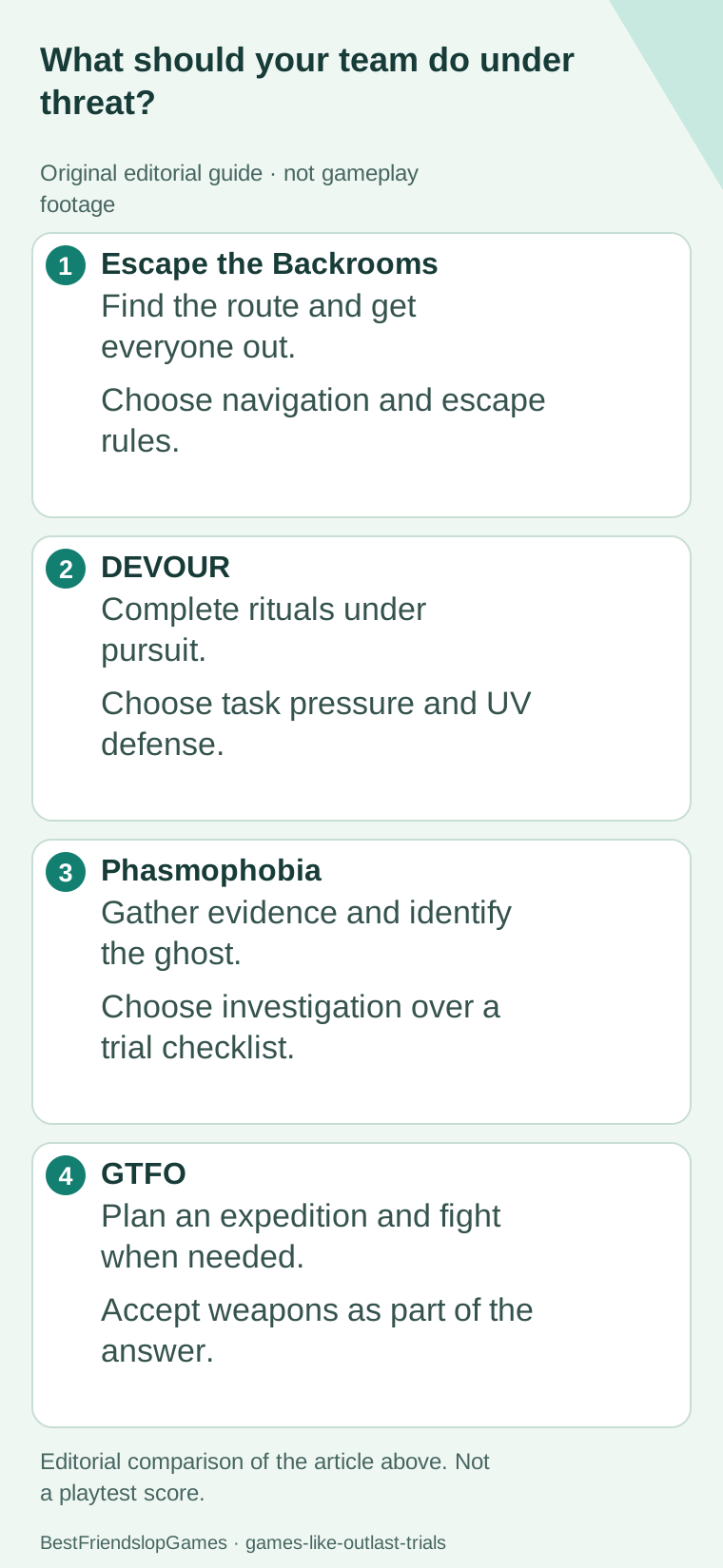
The best games like Outlast Trials depend on what your group wants to do while being threatened. Choose Escape the Backrooms for finding a way out together, DEVOUR for completing rituals while danger escalates, Phasmophobia for investigating and identifying a threat, or GTFO for planned expeditions with weapons. These are four different replacements for the cooperative trial loop, not interchangeable horror games. Decide whether your next evening should center on evading, finishing tasks, gathering evidence or fighting back.
Official descriptions, modes and US Steam prices checked October 20, 2026. This is a sourced comparison, not a playtest. The buying table covers Windows Steam base games; other editions and crossplay combinations require separate checks. Return to the wider Best Friendslop Games directory for other shared activities.
Keep the task under pressure, not just the frightening setting
The Outlast Trials' official description allows solo trials or teams of two, three or four. Mandatory objectives do not force cooperation. Its core avoidance loop includes tools that can stun, blind, reveal enemies through walls or heal people. Completing the assigned tasks opens the way out. Calling it simply a game where players have no way to defend themselves misses that distinction. This comparison concerns that cooperative loop, not a complete catalogue of its current modes.
An actual player question about buying The Outlast Trials separates enthusiasm for horror from discomfort with jump scares and uncertainty about playing with others. That is one person's preference, not evidence of general demand or a measured fear rating. It suggests a useful buying question: which kind of pressure does everyone actually want?
Our selection rule: Describe the moment you want to repeat before naming a replacement. Is it escaping with somebody who almost got left behind, finishing a dangerous job despite interruptions, piecing together information, or recovering a plan after an encounter goes wrong? Those moments imply different kinds of teamwork. Our shortlist separates them so a familiar corridor cannot do all the persuading. A player who dislikes being unable to confront a threat may welcome an armed alternative; someone who values that vulnerability may find the same change removes the attraction. Ask the group to choose its preferred response to danger first, then use price and availability to narrow the matching branch.
Four alternatives: players, modes and dated budgets
These are October 20, 2026 US Steam prices before tax. Sale prices and regular prices are separate. All four checked listings include online co-op; none lists shared/split-screen co-op. Counts refer to the arrangements documented here, not unofficial mods. The platform column is deliberately limited to the Windows Steam versions being compared.
| Game and official source | Verified party and mode | Checked platform | Current price; regular price | Main task and compromise |
|---|---|---|---|---|
| Escape the Backrooms | 1–4 players; solo or online co-op | Windows Steam | $9.99; $9.99 | Find the route out together; trade the trial assignment for level-specific escape rules |
| DEVOUR | 1–4 players; solo or online co-op | Windows Steam | $9.99; $9.99 | Complete rituals under pursuit; trade the facility setting for occult objectives and UV defense |
| Phasmophobia | Up to 4 players; solo or online co-op | Windows Steam | $13.99 sale; $19.99 | Identify the haunting through evidence; trade completing a prescribed trial for investigation |
| GTFO | A four-position team; online, with bots able to fill missing positions | Windows Steam | $10.39 sale; $39.99 | Plan and execute an expedition; accept firearms and tactical combat as central tools |
GTFO's four positions are not a requirement to find four humans, and bots do not create extra seats. A controller-support or Remote Play label is not proof of couch co-op. These distinctions matter before everyone buys the same game.
Escape the Backrooms: make reaching the exit the shared job
What stays: The official premise puts the team in hostile spaces where understanding entities and finding a way out matter. It specifies proximity voice, entities hearing players, and every team member needing to reach the exit alive to escape.
What changes: Each level has its own escape conditions and dangers. This is an exploration-and-escape recommendation, not a promise of the same trial structure, defensive upgrades or narrative presentation as Outlast Trials. The exact title here is Escape the Backrooms.
Our fit judgment: Put this branch first if the satisfying part of a trial is the conversation about where everyone is and how the whole group gets out. A common destination makes staying aware of other players part of the decision, rather than merely four people performing parallel chores. The compromise is that learning the environment becomes a major part of the evening. Agree whether the experienced player should explain the route or let newcomers discover it, because those are different social experiences even when the software is identical. If your friends chiefly want a familiar objective checklist and progression toolkit, do not sell a new maze as a replacement for those systems.
DEVOUR: keep objective work under pursuit
What stays: The official description combines searching for ritual items, completing a banishment and avoiding a possessed pursuer. Threats escalate as play progresses, and a UV flashlight provides defense. Randomized doors, objects and item locations change the search.
What changes: The assigned work becomes occult ritual preparation rather than Murkoff's trials. UV defense is not a copy of Outlast's selection of tools. DEVOUR also explicitly warns about loud jump scares; choosing it is not a verified way to remove those from the evening.
Our fit judgment: This is the branch to inspect when your group enjoys having something specific to finish while a pursuer makes execution awkward. The useful match is the conflict between advancing the objective and attending to danger. It is not simply that both games have people screaming in dark buildings. Before buying, ask whether the group wants pressure that rises around a repeated search-and-completion routine. A friend who mainly enjoys a variety of bespoke trial tasks may accept that trade, but should hear it before checkout. Conversely, if everyone wants a clear common job and is happy to learn its ritual logic, the different setting need not disqualify it.
Phasmophobia: turn the shared job into an investigation
What stays: Up to four people enter dangerous locations and coordinate equipment use. The store lists evidence tools such as EMF readers, thermometers, cameras and Spirit Boxes, alongside custom difficulty and the option to support an investigation from the truck.
What changes: The central question is what kind of ghost you are dealing with. That shifts the shared activity toward gathering and interpreting evidence. It is not the same assignment as completing a trial's prescribed tasks, and truck support should not be read as a universal promise of a fear-free role.
Our fit judgment: Choose this branch when the group wants uncertainty to produce discussion, not only a reason to hurry through a job. It gives a useful direction to people who enjoy comparing observations and revising an explanation together. The price of that change is a different learning goal: knowing what information matters can become as important as staying coordinated in the space. Set an agreement about hints before the first session. If one knowledgeable friend immediately supplies the conclusion, the rest may lose the reasoning activity they came for. If everyone wants a chase followed by a clean task checklist, explaining a mystery may feel like the wrong kind of interruption.
The existing games like Phasmophobia guide compares that investigation branch in more detail.
GTFO: keep expedition dependence, accept armed confrontation
What stays: Prisoners undertake dangerous assignments in a hostile facility. The official description stresses equipment planning, resource collection and careful movement around dormant enemies; light, noise and vibration can disturb them.
What changes: Firearms and tactical combat are integral to handling encounters. That is a substantial change from the avoidance-centered cooperative trial loop being compared here. GTFO's bots can fill missing positions, but the developer still emphasizes communication between human players.
Our fit judgment: Treat this as the deliberate alternative for a group that likes the preparation and dependence of a dangerous mission but wants fighting to be a meaningful response. Do not recommend it as the closest match merely because another set of prisoners enters another threatening building. Weapons change what the team must coordinate and what mistakes it needs to recover from. Ask the friend who most enjoys Outlast's vulnerability whether a combat-focused solution would preserve that appeal or replace it. Also agree whether everybody wants to discuss equipment before entering. The useful similarity is mutual reliance during an assignment; the major departure is how the group deals with opposition.
Agree on pressure and completion before buying
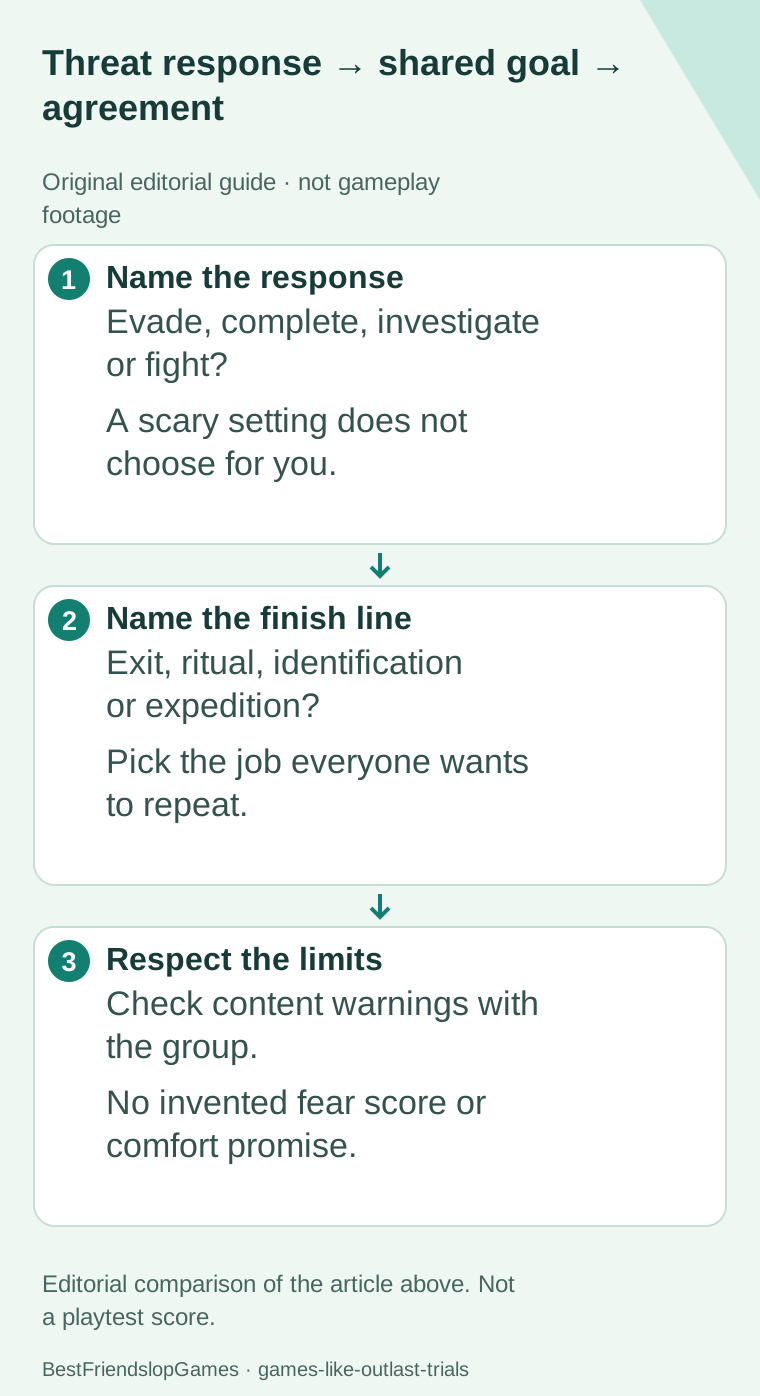
Use two questions: “What should we do when danger appears?” and “What should count as finishing the job?” Escape, ritual completion, identifying a ghost and clearing an expedition are distinct goals. None of those labels is a measured difficulty score or a guarantee about how frightening a game will feel.
Our group rule: Let each person veto a type of pressure without having to defend a universal claim that a game is too scary. Being comfortable with disturbing imagery does not necessarily mean enjoying sudden noise, and liking pursuit does not mean wanting to reason through evidence. Make two short lists: things the group wants to do and things somebody does not want to experience. Choose an overlap before comparing discounts. This avoids promising that company will automatically make horror comfortable or that a gun will remove tension. If there is no overlap, selecting a different shared activity is more honest than presenting any of these four as a guaranteed compromise.
Read the current store content warnings before purchase. This page does not assign an invented horror score or claim that any recommendation is jump-scare-free.
Price the copies you need, not the genre label
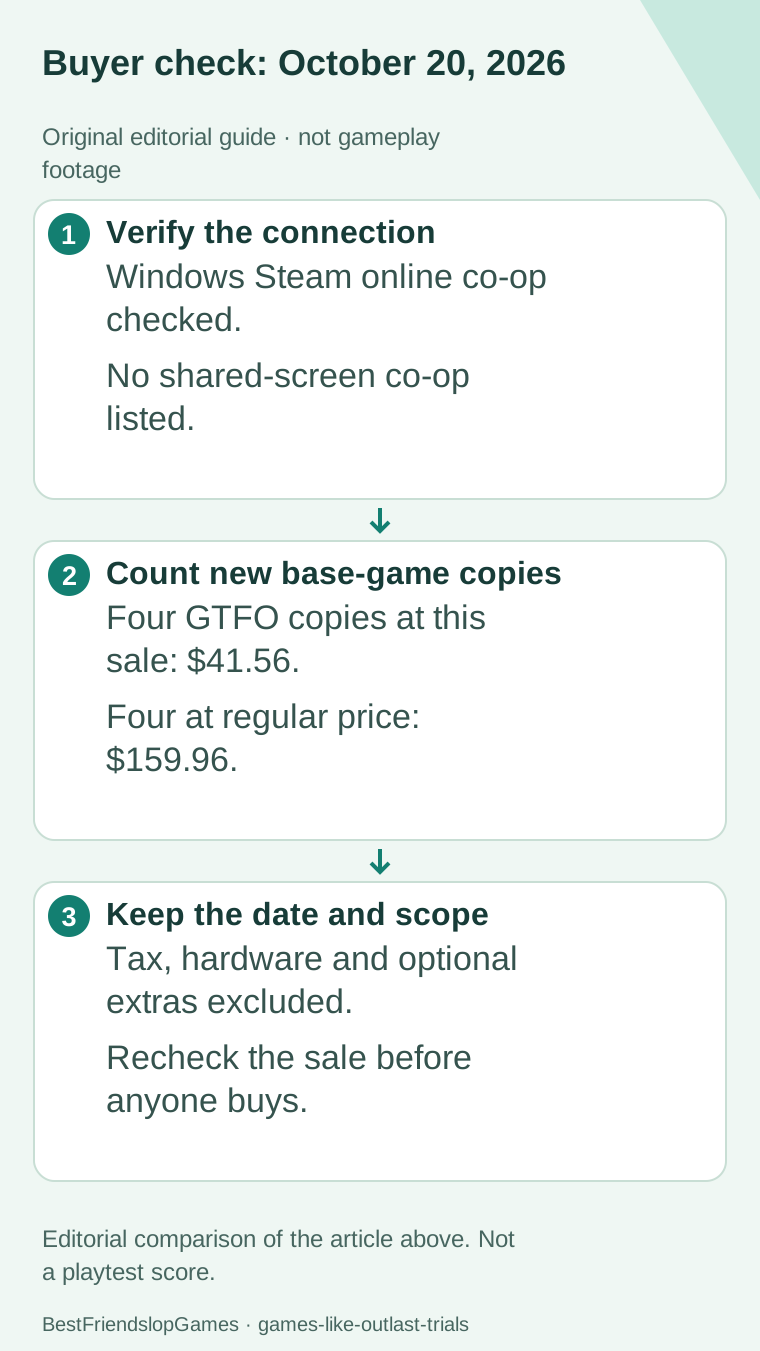
For four people who each need a new base-game copy, the dated totals are Escape the Backrooms: 4 × $9.99 = $39.96; DEVOUR: 4 × $9.99 = $39.96; Phasmophobia: 4 × $13.99 = $55.96 on sale, or 4 × $19.99 = $79.96 at regular price; GTFO: 4 × $10.39 = $41.56 on sale, or 4 × $39.99 = $159.96 at regular price. These totals exclude tax, hardware, optional extras and any separate subscription costs. Recheck checkout prices; a snapshot does not promise a sale's duration.
Our budget rule: Decide which branch fits before deciding whether a discount makes it affordable. In this snapshot, different activities have similar four-copy costs; that does not make their compromises interchangeable. A cheaper purchase can still leave the group without the experience it agreed to try. Count only people who need another copy, then ask each person whether the actual total is acceptable. Keep the regular-price column visible so a friend buying after the sale can make a fresh choice instead of relying on an expired group calculation. If the price changes, recalculate the cost; do not silently change the agreed activity to whichever title now has the largest discount.
Check the actual connection arrangement
Our access rule: Confirm the exact edition, device and connection plan for every participant before sharing a purchase link. A maximum of four tells you how many positions the documented arrangement has, not whether a console player can join a Steam owner or two people can share one screen. Keep those questions separate. Likewise, an optional bot can solve an empty position without providing the conversation a missing friend would have supplied. For a smaller gathering, decide whether the intended evening is exploring with the people present or recreating a full group's coordination. Where this page has not verified a platform combination, leave it unconfirmed rather than filling the gap with the general label multiplayer.
Quick questions
Which option is closest to doing tasks while being chased?
DEVOUR is our task-under-pursuit branch because its official description connects ritual objectives with escalating pursuit and UV defense. Escape the Backrooms is the alternative when the group primarily wants to understand a hostile space and get everyone out. Neither is a complete Outlast Trials substitute.
Which option lets the group fight with guns?
GTFO makes armed combat central alongside stealth and expedition planning. Choose it because that change is wanted, not because a similar facility setting guarantees an identical experience.
Can these four games be played on one couch and screen?
The checked Steam listings advertise online co-op and do not list shared/split-screen co-op. This guide does not verify unofficial local-play solutions or every other platform edition. Do not buy a single copy assuming it supplies four local seats.
Does a smaller group have to find four human players for GTFO?
No. Its official description allows bots to fill missing positions in the four-position team. That confirms a fallback, not equivalent communication or a guaranteed difficulty level with fewer people.
Sources and scope
The five linked official Steam listings supplied the baseline, group sizes, mode categories, gameplay descriptions and October 20, 2026 US price snapshots. The linked public question supplied a reader preference, not technical facts. What-stays and what-changes summaries are sourced; paragraphs labelled “Our” are editorial decision rules inferred from those facts. The diagrams are original explanatory artwork, not screenshots or evidence of hands-on testing. No claim is made that every alternative, platform or current Outlast mode is covered.