What Is Friendslop? A Practical Definition for Co-op Game Night
Friendslop is an informal label for multiplayer games where a simple shared job gives friends room to create the memorable moments themselves. Communication, improvised plans, and funny mistakes matter as much as finishing the task. The word can be affectionate or dismissive; it does not mean every co-op game is poorly made, cheap, or horror-themed.
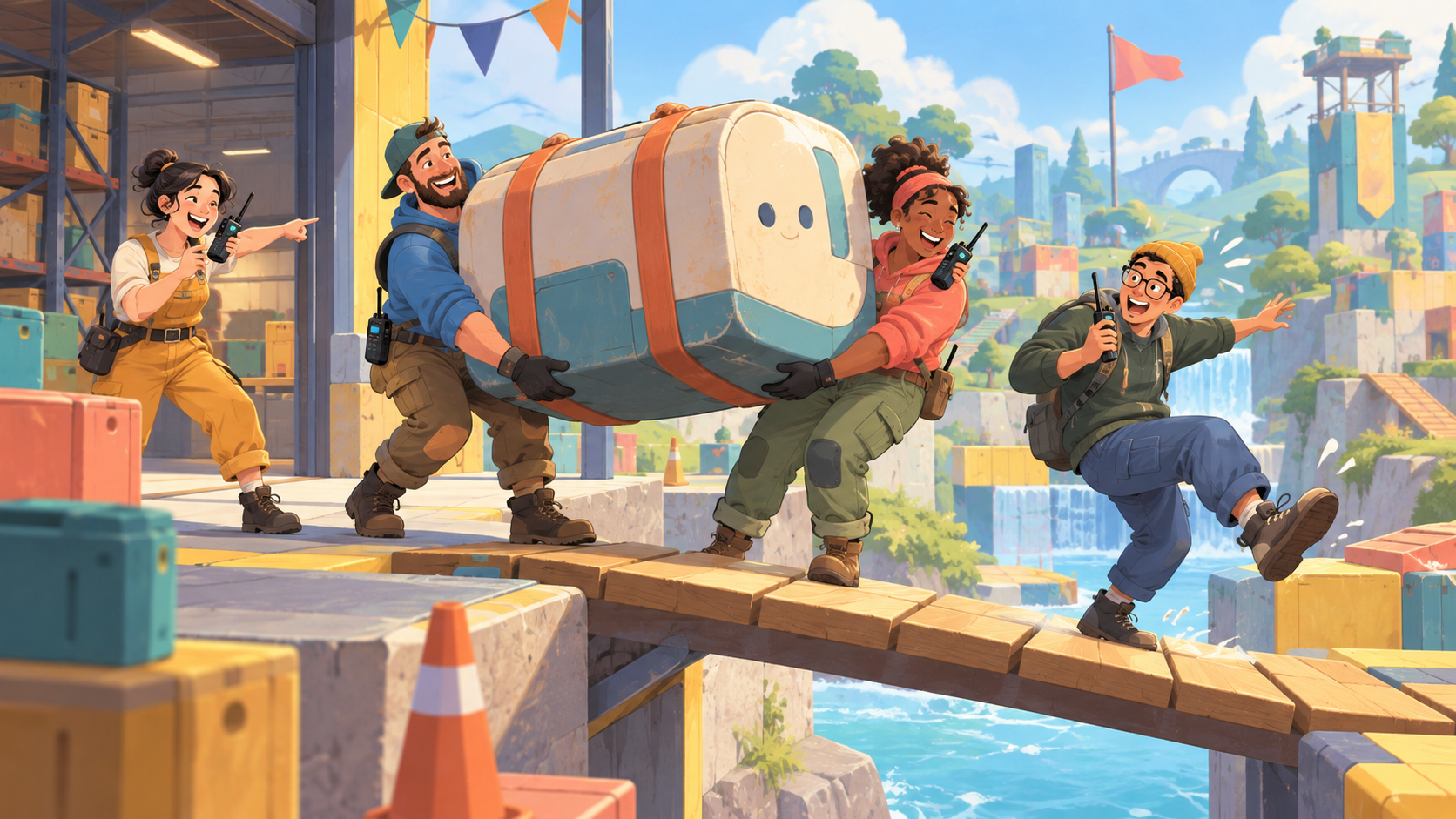
The short definition, with a boundary
Think of the difference between playing alongside friends and needing the group to make the situation interesting. In a friendslop game, a clear task—carry an object, reach a destination, gather footage, or survive a shift—keeps everyone pointed the same way. The unpredictable part is how the group talks, divides work, misreads a situation, and recovers together.
“Friendslop” is player slang, not a fixed store genre. Some people use the word “slop” as criticism of rushed imitators; others use the whole term warmly for a chaotic night with friends. A public discussion about the name shows that disagreement directly. Use the label to describe a kind of social play, then judge the individual game on its own merits.
The three-part friendslop test
This is our editorial test, not a rule issued by a platform or developer. A game is a strong fit when all three answers are yes:
- Is there a job the whole group can understand quickly? A quota, climb, extraction, delivery, or shared puzzle gives the conversation a direction.
- Can one player's choice change another player's moment? Passing tools, calling out danger, holding a route, or making a bad decision should affect the rest of the group.
- Can a mistake become a story the group tells later? The failure should create a new social situation, not merely send each player back to an isolated retry screen.
The test deliberately leaves out art budget, price, horror, and streaming potential. Those features may be common in examples, but none is necessary to create a social-first game.
Four buying checks before you invite everyone
The definition tells you what kind of experience to expect. It does not tell you whether the game fits your Friday night. Use this original screening table before sending a store link to the group:
| Check | Ask this before purchase | Why it matters |
|---|---|---|
| Group size | Does the official mode fit everyone who is actually joining? | A four-player cap can exclude the fifth friend even when a list calls the game “multiplayer.” |
| Communication | Does the game depend on proximity voice, ordinary voice chat, or visible co-operation? | A microphone-shy group may miss the very system that creates the memorable moments. |
| Failure cost | After one person falls or a run fails, can everyone rejoin the fun soon? | A comic mistake stops being comic if someone watches for most of the session. |
| Playable status | Is the game released, a demo, or only on a watchlist today? | A promising trailer is not a game the group can install tonight. |
These checks separate category fit from group fit. A game may clearly be friendslop and still be a poor choice for a particular group.
Apply the test to real games
- Lethal Company: strong fit, horror warning. The official page gives the crew a scrap quota, tools, a ship role, and hazards that make communication consequential. It says the current game supports up to four players and remains in Early Access. A five-person group needs a different pick.
- R.E.P.O.: strong fit, horror warning. Its official description combines up to six players, physical object handling, extraction, and proximity voice. One clumsy carry can become the whole team's problem. The store lists it in Early Access.
- Big Walk: social-first, gentler, and a useful boundary case. Its official page emphasizes talking, gestures, tools, shared navigation, and 2–12 players. It also describes a hand-crafted adventure with an ending, so it is more authored than a throwaway sandbox. That does not erase the group's role in the moment-to-moment story.
- PICO PARK 2: adjacent rather than an automatic label. A 2–8-player puzzle can create shared mistakes and timing problems, yet its designed levels remain the main attraction. Call it a co-op puzzle first; use “friendslop” only if your group means the social chaos, not a precise genre boundary.
This comparison is an inference from the developers' descriptions and our stated test, not a claim that we played or timed these games ourselves. Player caps, modes, and release status were checked against the linked store pages on September 27, 2026.
Is “friendslop” an insult?
It can be. The suffix suggests low effort or repetition, and creators may reasonably dislike having thoughtful work placed under it. The same word is also used by players as shorthand for games that turn a voice call into an adventure. A respectful recommendation names the actual mechanic and its limits rather than using the label as a quality score.
Is every co-op game friendslop?
No. A co-op game can be excellent because of a tightly written campaign, demanding combat, or carefully authored puzzles. Friendslop points to the unusually large role of group interaction in producing the fun. The boundary is fuzzy; the three-part test makes our usage transparent instead of pretending the word has one official meaning.
Does it have to be scary, cheap, or new?
No. Big Walk shows how conversation and navigation can create social chaos without a monster chase. Our non-horror guide separates that gentler option from puzzle pressure, sabotage, and cartoon combat. Price and release year do not decide whether a group makes the story.
Choose a game for tonight
Start with the best friendslop games overview for playable picks and a clearly separated watchlist. If your lobby has exactly five people, use the five-player guide; if cost is the barrier, use the free-games guide. First answer the four buying checks, then pick the kind of shared mistake your friends will actually enjoy.