Couch Co Op Games: Local Players, Shared Jobs and One-PC Budgets
Good couch co op games for one PC include It Takes Two for an exactly two-player story, Moving Out 2 for two to four people moving furniture together, Overcooked! All You Can Eat for two to four cooks sharing kitchen jobs, and Unrailed! for two to four people building track ahead of a train. Choose by the number of simultaneous local players first, then by the activity and pressure everyone wants. For the one-PC setups below, budget one base-game copy, not one copy per person; compatible controls and hardware are separate.
Official sources and US Steam prices checked October 21, 2026. This is a focused list of four documented Windows Steam options, not a ranking of every local multiplayer game or a hands-on hardware test. Console availability, controller compatibility and prices can differ by edition. For other ways to play together, see Best Friendslop Games.
Start with simultaneous local seats
Here, couch play means people using the same game device and display together. Split-screen is one way to show those players, not a requirement that every local game divides the picture. Native online play, LAN play and streaming a local game to somebody elsewhere are different arrangements. The four Steam listings below explicitly include shared/split-screen co-op; their descriptions or publisher guidance also establish the player counts.
Our selection rule: Write down the number of people who should be actively playing at once before browsing recommendations. Two people enjoying a story while two others watch is a valid evening, but it is not a four-player game. If taking turns is acceptable, agree on that explicitly rather than discovering the limit after purchase. Then choose whether the group wants complementary character roles, handling physical objects, managing a workflow or maintaining a shared construction project. These four options make those activities visible. A familiar genre label tells you less about the gathering than who can participate and what each person will actually contribute.
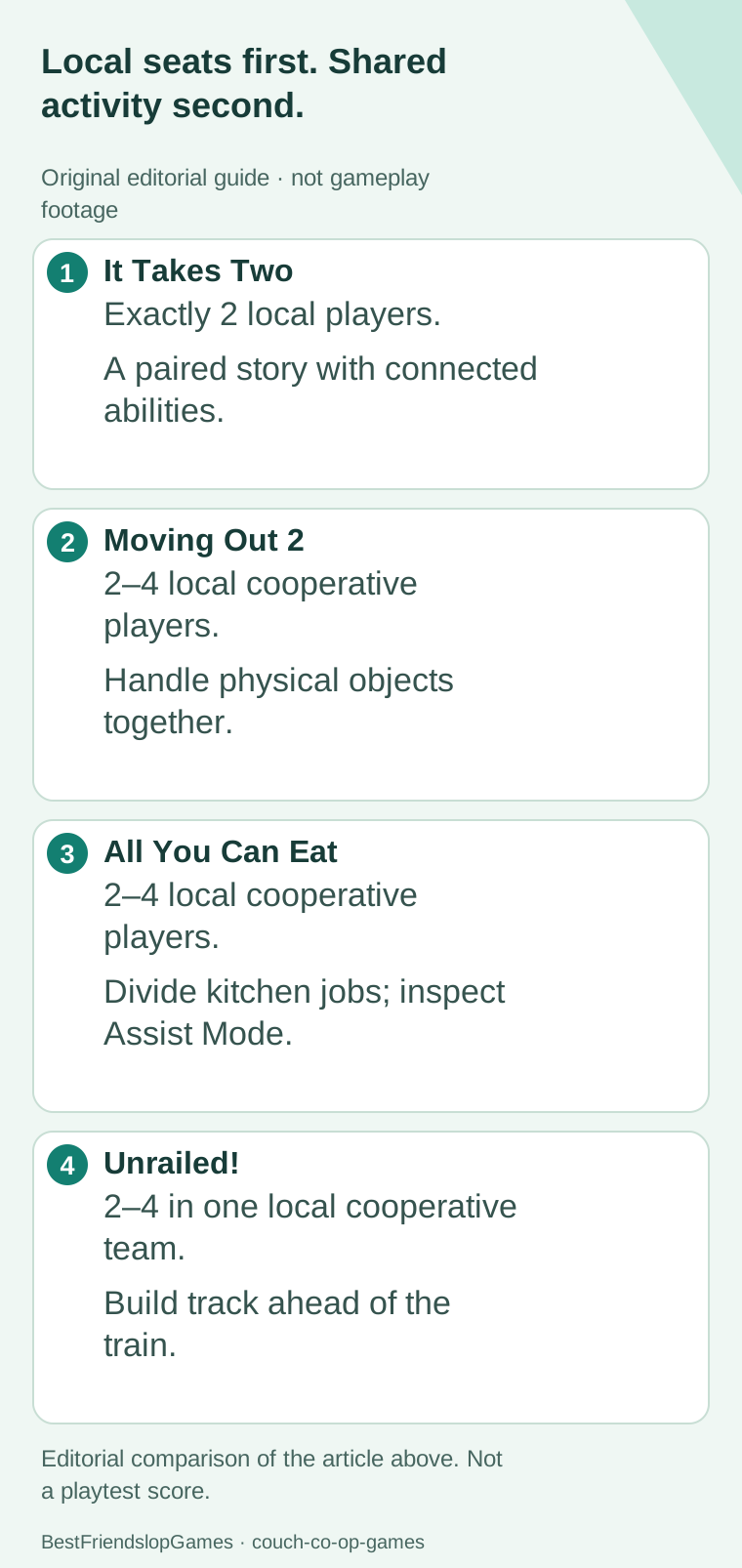
The shortlist: local players and one-PC costs
The cooperative counts include everyone on the device. Solo availability, where present, does not add another seat. Prices are US Steam base-game snapshots before tax on October 21, 2026; hardware, controllers and optional extras are excluded. Each one-PC total below is 1 × the displayed current price. All four also list online co-op, but this table is specifically about playing locally.
| Game and official source | Simultaneous local co-op | Shared activity | Current one-copy price; regular price | Pressure or setup distinction |
|---|---|---|---|---|
| It Takes Two | Exactly 2; split-screen | A story adventure with connected character abilities | $39.99; $39.99 | Built for a pair, not a three- or four-person team |
| Moving Out 2 | 2–4; local co-op, solo also listed | Move and transport objects through physical challenges | $7.49 sale; $29.99 | Assist mode is listed; inspect its settings rather than assuming every challenge is relaxed |
| Overcooked! All You Can Eat | 2–4; local co-op, solo also supported | Prepare and serve dishes as a team | $11.99 sale; $39.99 | Assist mode can slow recipe timeouts and increase round timers |
| Unrailed! | 2–4 in one cooperative team; solo also listed | Gather materials, make track and extend the railway | $2.99 sale; $19.99 | The train creates forward pressure; split-keyboard and split-controller modes are explicitly listed |
Team17's updated All You Can Eat FAQ confirms up to four total players, offline and online. Moving Out 2's store specifies a player plus up to three friends and local multiplayer. Unrailed!'s description separately identifies its cooperative team and its two-versus-two competitive mode; this list recommends the cooperative arrangement, not versus play.
1. It Takes Two — for a pair that wants a shared story
Documented fit: The official store describes an adventure built for two, with couch and online split-screen play and different, connected abilities across levels. It does not offer a solo version of that campaign or four simultaneous local seats.
Setup boundary: Friend's Pass and Remote Play are mentioned by the publisher for inviting another person. They are not evidence that a third person can join the local story. The one-PC cost here is one full base-game copy; this is not a claim that both people need separate purchases.
Our fit judgment: Choose this when two people want to work through a continuing experience together rather than host a rotating party. The important advantage of a fixed pair is that both participants can treat their contribution as part of the shared journey, not a spare job assigned to whoever arrived last. The compromise is social flexibility. If somebody else is likely to join, decide whether watching or taking turns will be welcome; do not describe that as expanding the game. Also agree whether both players want the story and the action. Being together on the sofa does not automatically make every platforming challenge a comfortable choice for both people.
For alternatives to this particular adventure, use the existing games like It Takes Two comparison. This page remains a local-play list, not a second version of that guide.
2. Moving Out 2 — for physical teamwork with up to four people
Documented fit: The official description offers solo play or a team with up to three friends, local or online. Its activity is a physics-based moving job across unusual environments. Assist mode and accessibility options are explicitly listed.
Setup boundary: This entry is Moving Out 2, not the first Moving Out. A local session is covered by the checked co-op category; a particular mixed local/online setup or controller model still needs its own check. Assist mode is a feature, not a measured guarantee that everybody will find it easy.
Our fit judgment: Pick this branch when the group wants a common object or destination to talk about. “Where should this go?” can be a clearer starting conversation than asking a new player to understand a specialized combat role. That is an editorial reason to shortlist it, not a claim that we measured its learning time. Decide whether the group wants to experiment with awkward movement or optimize each job. Those intentions can conflict even when the controls are shared. If a newcomer is still learning, let the whole team agree on assistance and expectations before treating every clumsy action as a failure that somebody needs to correct.
3. Overcooked! All You Can Eat — for dividing kitchen jobs
Documented fit: Players coordinate preparation and service in changing kitchens. The current listing describes campaign, survival and practice modes, plus assistance that can extend round timers, slow recipe timeouts and allow level skipping. The publisher confirms up to four offline players.
Setup boundary: All You Can Eat is a distinct release. Team17's FAQ says it does not play online with an owner using Overcooked 2; owning one is not the same as owning the other. The local purchase in this table is specifically All You Can Eat. The existence of a competitive mode does not change the cooperative recommendation.
Our fit judgment: Choose the kitchen when the pleasure is dividing a process and noticing where it has become blocked. It can give a group a concrete way to redistribute work, but the conversation needs to remain collaborative. Before starting, distinguish “we want to improve our score” from “we want everyone to try every job.” The first can favor stable assignments, while the second benefits from rotating responsibilities even if the result is less efficient. Neither goal is wrong. Discuss assistance before frustration rather than using it as a verdict on the newest player. The useful question is whether the group enjoys coordinating work, not whether its members enjoy cooking in real life.
The existing games like Overcooked page explores other shared-work games without creating another local-play target.
4. Unrailed! — for one cooperative construction pipeline
Documented fit: The official description combines resource collection, track crafting and railway extension ahead of a moving train. It lists up to four cooperative players, local and online play including mixed sessions, several modes, and split-keyboard and split-controller options.
Setup boundary: This recommendation is the original Unrailed!, not a sequel. Its two-versus-two option is competitive and is not the team mode being recommended. Shared input modes do not prove that every keyboard or controller arrangement will feel comfortable for your group.
Our fit judgment: Put this on the list when everyone wants their individual task to feed a clearly visible common project. Gathering material and placing useful track are connected decisions, which makes the handoff itself a useful topic of conversation. The tradeoff is that the project moves the group forward rather than waiting for an open-ended building plan. Ask whether that pressure is the attraction or the thing the gathering is trying to avoid. Start by agreeing who will watch the next bottleneck, then permit roles to change. A cheaper copy is not a reason to choose a moving deadline for people who wanted time to discuss every construction choice.
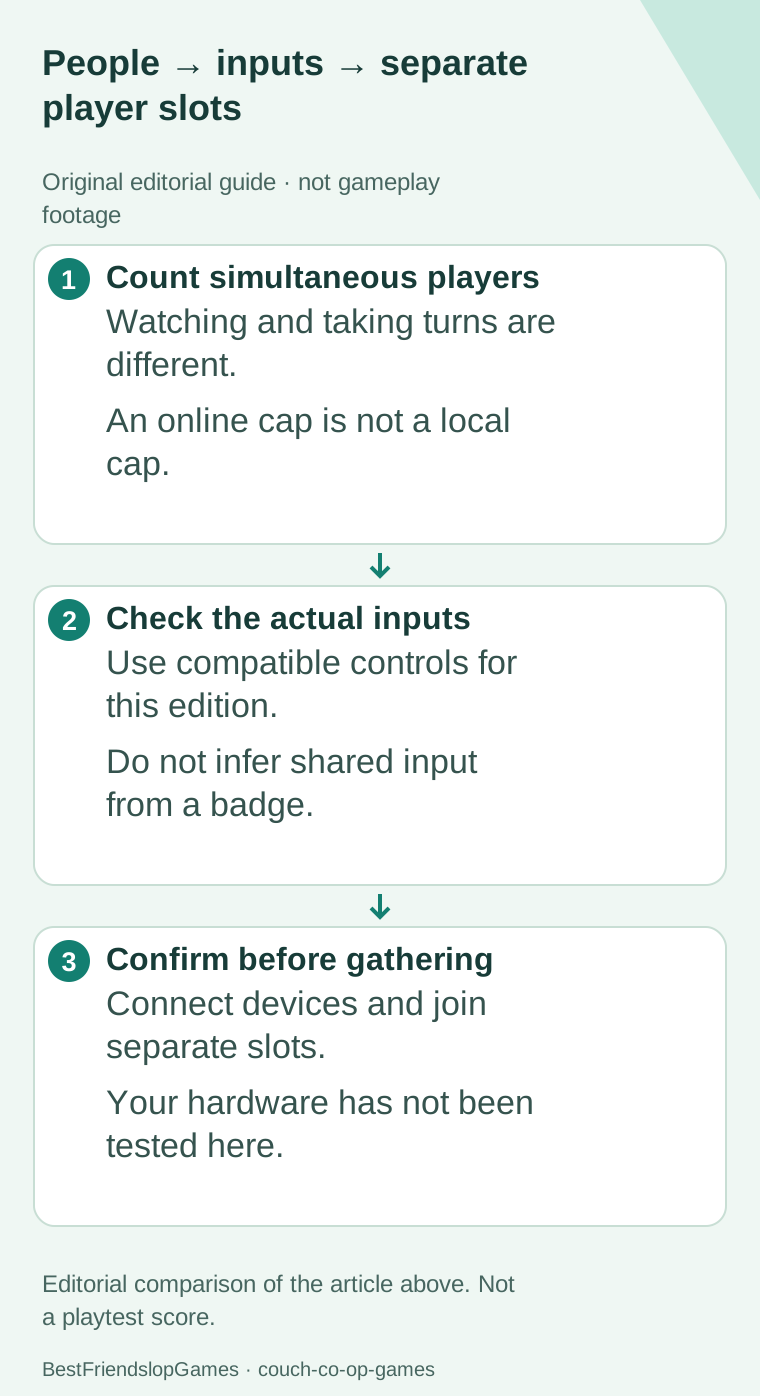
Check controls before choosing the final game
An EA forum question about using a single controller and a PC keyboard illustrates a separate issue from player capacity: a device may connect to the computer without the game assigning it as the intended second player. It is a reported setup problem, not proof that all controllers fail or a universal fix for today's versions.
Our access rule: Make a seating plan that lists people, input devices and the one machine running the local game. Treat a full-controller-support badge as a reason to check the specific controller, not a promise that any collection of devices will join automatically. Connect the intended inputs and confirm separate player slots before the gathering starts. If you plan to share a keyboard or controller, verify that the exact game supports that arrangement instead of transferring Unrailed!'s documented option to the rest of the list. Keep a fallback that the group accepts, such as taking turns, without relabelling it as simultaneous play or buying extra copies to solve an input problem.
This article has not tested your controller models, wireless connections, television or PC. One copy also does not prove that every game will launch without an account, initial installation or internet check. Confirm those requirements in the current store and launcher before relying on a disconnected setup.
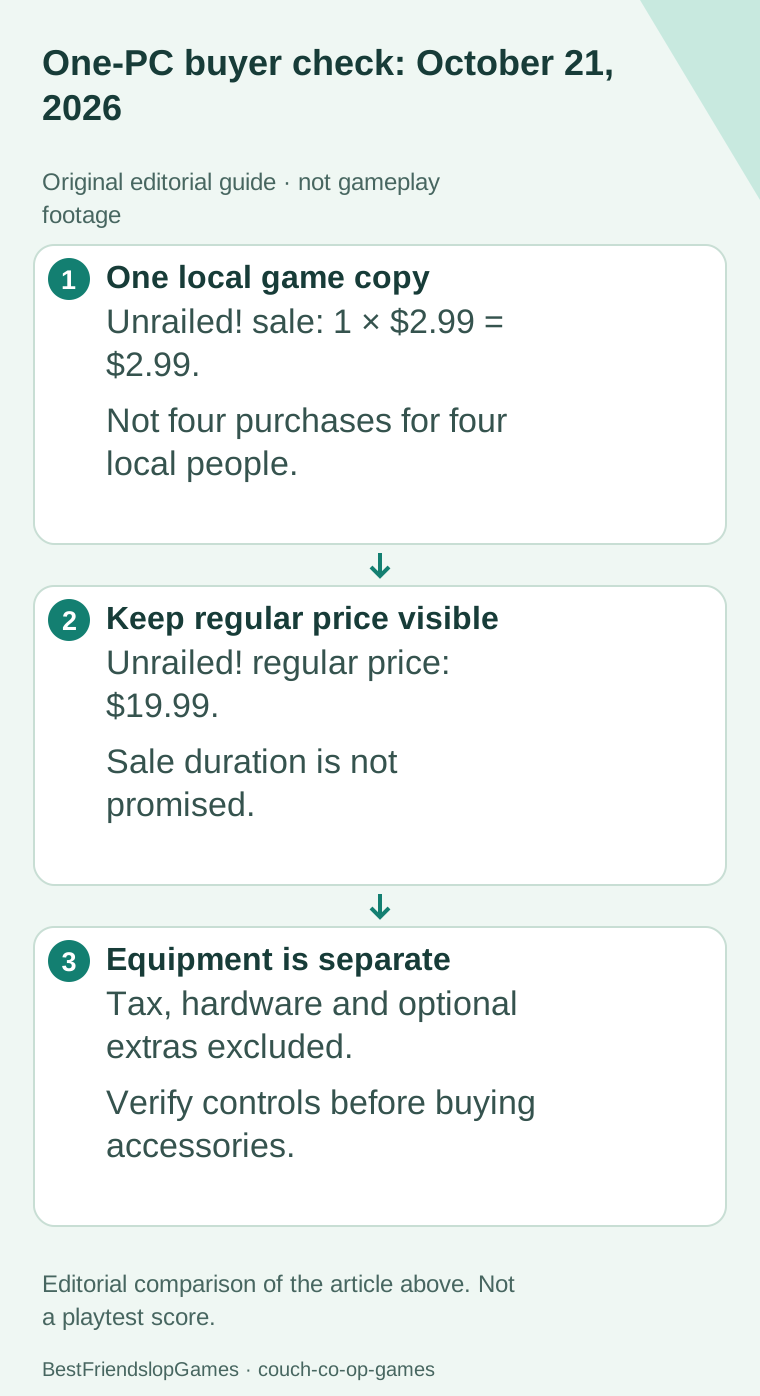
Budget the room, not four separate online machines
For a new one-PC local setup with the necessary hardware already owned, base-game cost is 1 × price: It Takes Two $39.99, Moving Out 2 $7.49, All You Can Eat $11.99, or Unrailed! $2.99 at this check. Those are alternatives, not a shopping bundle. If the sale ends, the listed regular prices give a separate reference; recheck actual checkout totals rather than assuming an end date.
Our budget rule: Keep software and equipment on separate lines. A low game price does not establish a low evening cost if the chosen arrangement needs controls you do not own. Equally, four people sharing one local session do not justify multiplying the software price by four. Count the new licences required for the arrangement you actually verified, then add any equipment only after confirming compatibility. If one person owns the game already, check whether that person's machine is the one you intend to use before counting the cost as zero. A price comparison is useful only after the seating plan works; it should not decide the seating plan for you.
Match the pressure to the gathering
Our activity labels are editorial guidance, not difficulty scores. It Takes Two offers a fixed pair's adventure; Moving Out 2 offers object-handling jobs; All You Can Eat offers kitchen workflows; Unrailed! offers a railway construction pipeline. Assistance options and the ability to play locally are documented facts, but neither guarantees an equally relaxed experience for every participant.
Our group rule: Agree on what a good attempt looks like before anybody starts giving instructions. For one group it may mean completing the task efficiently; for another it may mean every person understanding one new responsibility. Choose the game and settings around that agreement. When someone makes a mistake, ask whether the setup, role assignment or pace needs changing before deciding that the person is the problem. If a player wants to stop, a supported local seat is not an obligation to keep playing. The advantage of gathering in one room is being able to discuss those preferences directly, not evidence that any particular title will suit every family or friendship.
Quick questions
Which of these couch co op games fit four local players?
Moving Out 2, Overcooked! All You Can Eat and Unrailed! support a cooperative group of up to four in their documented local arrangements. It Takes Two is exactly two. Four spectators and players combined do not change that limit.
Do we need one game copy for each person on the couch?
Not for the one-PC local arrangements described here: the budget is one base-game copy on the host machine plus suitable inputs. Separate computers, remote players and other editions need a different ownership check.
Does Remote Play Together mean the game has native local co-op?
A streaming label alone is not the evidence used here. Each recommendation also has a local co-op category and a documented group arrangement. Remote participation changes the connection requirements; it does not automatically add local seats.
Which option has controls for reducing kitchen pressure?
All You Can Eat specifically lists an Assist Mode with slower recipe timeouts and longer round timers. Moving Out 2 also lists Assist Mode, but this page does not claim the two games expose identical settings. Check the exact options together before starting.
Sources and scope
The linked official Steam listings supplied the October 21, 2026 US prices, local/online categories and gameplay descriptions. Team17's linked updated FAQ corroborated All You Can Eat's offline cap and edition distinction. The EA forum question is a real user's setup concern, not a hardware test by this site. Paragraphs labelled “Our” are original editorial decision rules derived from those facts. The three diagrams are explanatory artwork, not gameplay images. Historical facts in other guides remain dated to their own checks.