Co Op Games for 3 Players: Give the Third Seat a Real Job
The best co op games for 3 players give all three people a useful responsibility at the same time. Choose Warhammer 40,000: Space Marine 2 for a native three-player online Campaign, Operations or Siege group, Remnant II for a three-person combat and build team, Trine 5 in Classic mode for three distinct heroes with local or online play, or Ravenswatch when your trio wants an online run that can also expand to four. Count active jobs, not just lobby capacity, before buying.
Official developer and US Steam records were checked October 31, 2026. This is a sourced comparison, not a playtest. Prices below are regular base-game prices before tax, not promises about temporary sales. Platform subscriptions, hardware, accounts, DLC and other storefronts are outside the totals.
Compare three seats, modes and regular entry cost
The table separates an exact three-person structure from an “up to four” room. Both can fit three friends, but they solve different attendance problems. A native trio preserves three jobs. A flexible room survives a fourth arrival but may distribute responsibility differently.
| Game and official source | Documented room and mode | Third-seat evidence | Regular US PC price checked Oct. 31 | Three new copies |
|---|---|---|---|---|
| Space Marine 2 / Steam | Three-player Campaign and replayable PvE; online only; full PvE crossplay documented | Campaign has three Battle-Brothers; Operations permits one Marine of each class; Siege is a three-player mode | $59.99 | $179.97 |
| Remnant II / Steam | Solo or online co-op with two other friends | Three builds can combine skills, weapons and independent Archetype progression | $49.99 | $149.97 |
| Trine 5 / official FAQ | Local or online; Classic mode caps at three, Unlimited mode at four | Classic allows one Amadeus, one Zoya and one Pontius, giving each person a named hero | $29.99 | $89.97 |
| Ravenswatch | Solo or online co-op with up to four players | A trio can choose three heroes and expand later; four difficulty levels and custom modes are documented | $24.99 | $74.97 |
The arithmetic is 3 × $59.99 = $179.97, 3 × $49.99 = $149.97, 3 × $29.99 = $89.97 and 3 × $24.99 = $74.97. Recheck the exact edition, current price and platform arrangement immediately before purchase. A lower temporary sale does not make an unsupported local room or unwanted difficulty a fit.
Editorial rule: Give every candidate a third-seat test. Write down one decision, one action and one recovery responsibility that belong to the third player. If the only answer is “extra damage,” the lobby may fit three while the activity still feels designed for two leaders and one follower. Keep the game only when the third person can change the plan before failure, contribute during execution and help recover afterward.
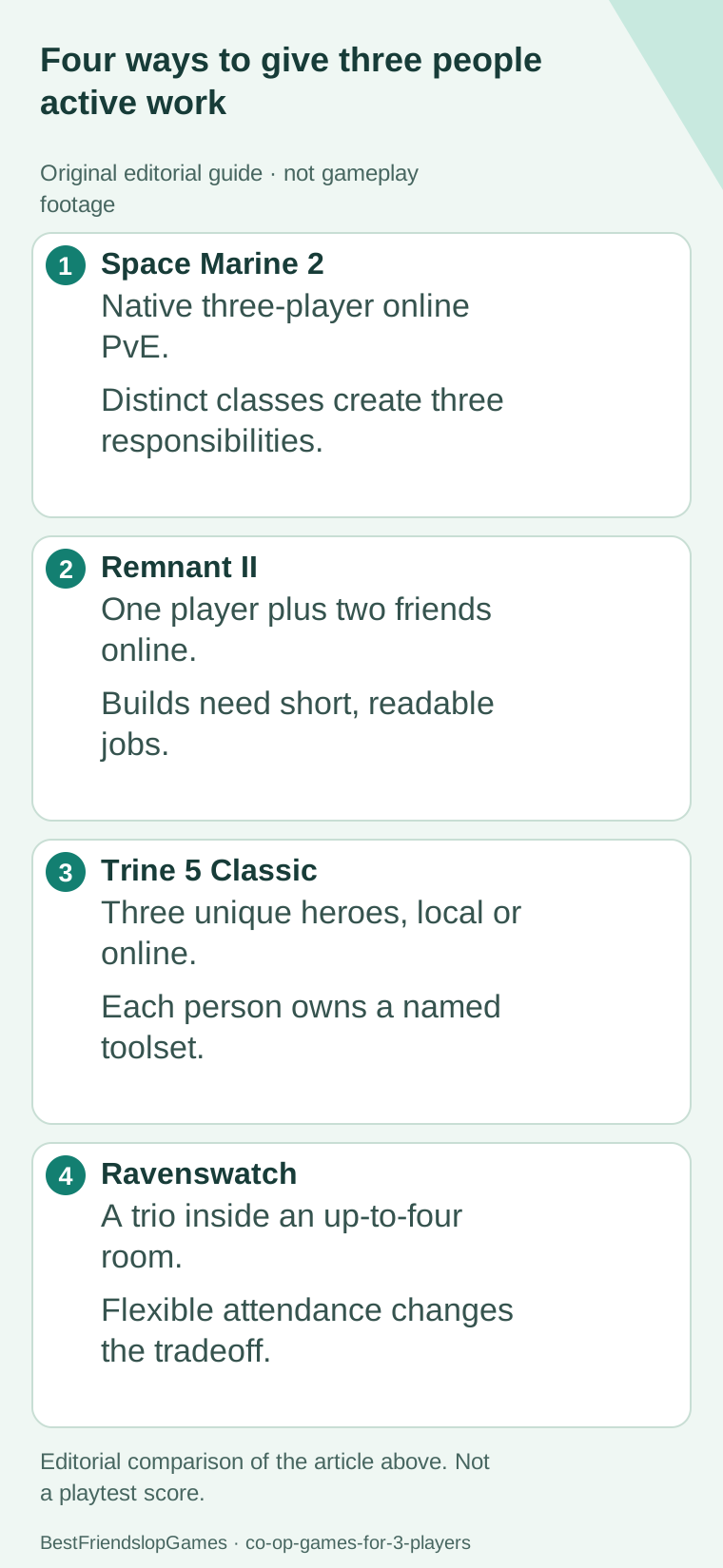
Space Marine 2: choose a native online trio
Saber’s official FAQ says Campaign and replayable PvE missions support three-player co-op with up to two friends. It also states that co-op is online only, LAN is unsupported and PvE crossplay covers Steam, Epic Games Store, PlayStation 5 and Xbox Series X|S. Operations squads may include only one Marine of each class. The official mode page describes Operations with two mates and Steam describes Siege as a three-player mode.
That class restriction is useful evidence for a trio because it prevents three identical roles in Operations. It is also a boundary: three friends cannot all select the same class. The FAQ says there is no friendly fire in Campaign, Operations or Eternal War, while voice chat, a communication wheel and PC text chat are available.
Editorial rule: Assign class choice by responsibility, not by who clicks first. One player owns immediate survival, one owns dangerous targets and one watches the objective or route. Reassign after a mission if one person spent most of the time following calls without making any. The official one-class-per-squad rule creates distinct slots; the group still has to turn those slots into equal permission to decide.
Remnant II: choose three builds that explain themselves
The official Remnant II site says players can go solo or cooperate with two other friends. It describes ranged and melee combat, large bosses, gear choices for different biomes, independent Archetype progression and skills that groups can combine. Steam lists online co-op, not shared-screen co-op, and the regular Standard Edition price is $49.99.
Three seats do not automatically create three understandable builds. Gear, Archetypes and boss patterns can make one experienced player’s explanation much longer than another person’s turn. The game’s official description supports team specialization; it does not guarantee equal onboarding or a particular host-transfer arrangement.
Editorial rule: Before the first difficult encounter, each player gives a twenty-second build statement: “I create this opening, I need this resource, and I recover when this happens.” If one statement requires a lecture, simplify that build before increasing difficulty. The goal is not perfect optimization. It is a team where the third person can predict when to act without waiting for a permanent commander.
Trine 5: choose three named heroes on one screen or online
Trine 5 supports local and online co-op. Its official Steam page says puzzle difficulty adapts to player count and lists one to four players. The developer’s Steam FAQ makes the important distinction: Unlimited multiplayer permits four players who may choose any hero, while Classic multiplayer permits three because only one instance of each hero can exist. Those heroes are Amadeus the Wizard, Zoya the Thief and Pontius the Knight.
This is the clearest exactly-three role map in the shortlist. It also creates a negotiation: one person may prefer another hero’s movement or puzzle tools. Local input still needs checking; the FAQ supports one keyboard plus controllers on PC and warns that multiple keyboards are unlikely to work.
Editorial rule: Let the least-confident player choose a hero first, then rotate only at an agreed checkpoint. The other two may describe what their own tools can do, but they should not seize the first player’s puzzle. A named three-hero structure is valuable when each player owns discovery. It loses that value when the quickest solver turns the other two seats into extra hands.
Ravenswatch: choose a trio that may become four
Ravenswatch’s Steam page says it is playable solo or with up to four players in online co-op. It lists four difficulty levels and customized modes. The regular base price is $24.99. Unlike Trine 5 Classic or the documented Space Marine 2 trio modes, the room is not locked to exactly three.
That flexibility is the reason to choose it. A regular fourth friend can join without changing games. The tradeoff is that the page does not promise that every three-hero combination covers every preferred function, nor does “up to four” establish local co-op. The official Steam features list online co-op only.
Editorial rule: Pick this when attendance changes more often than roles do. Before a run, name the missing fourth-seat assumption: no fourth person is expected, a late arrival may join the next run, or the group is intentionally staying at three. Then choose heroes around the current room. Do not make an absent friend responsible for a role and do not leave the third player carrying two undeclared jobs.
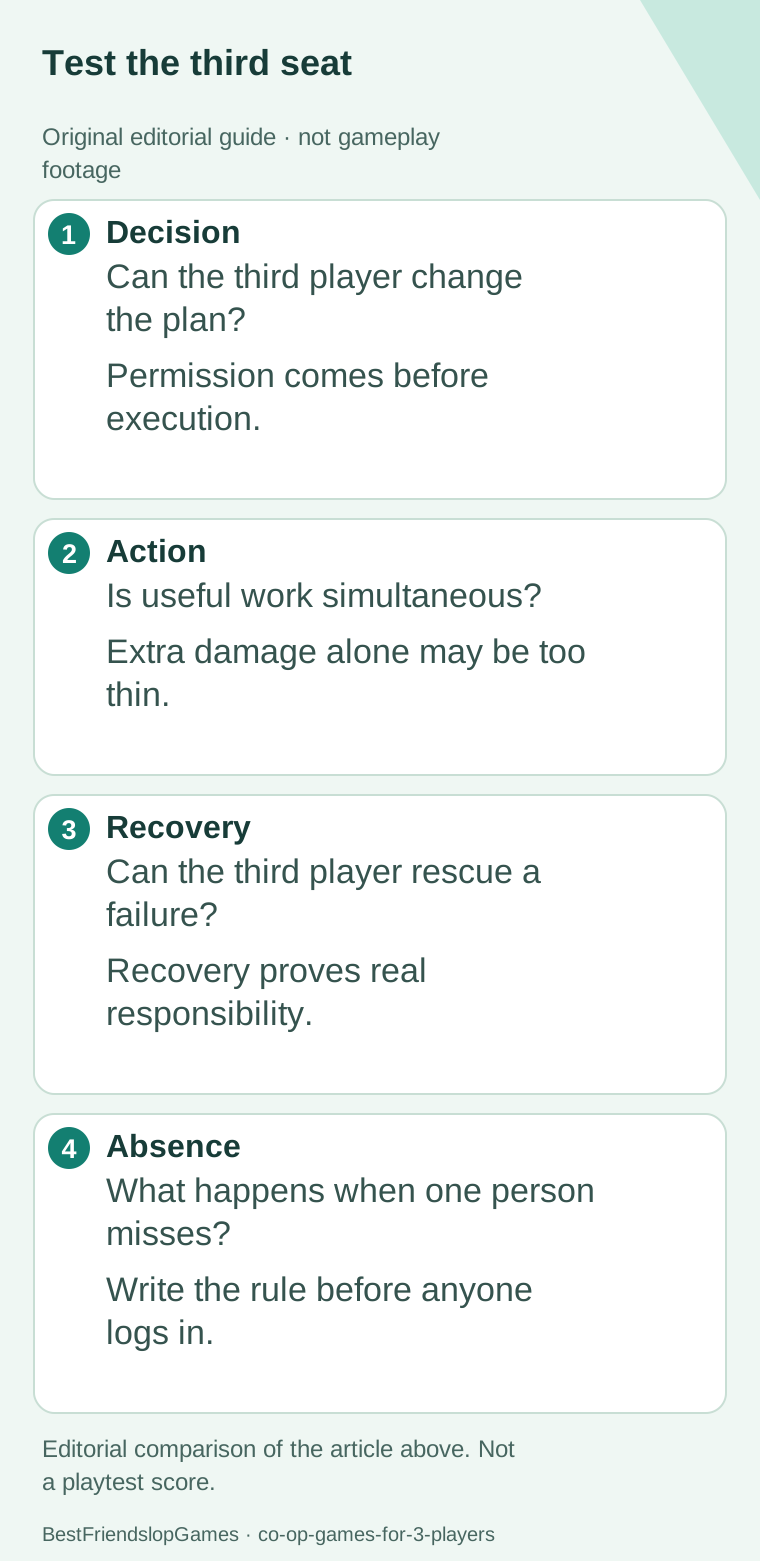
Use the third-seat test before the genre test
A trio can reject a good game for a structural reason. One player may become navigator, one may execute most actions and the third may wait. A large lobby cap does not reveal that pattern. The useful comparison is whether responsibility is simultaneous, visible and recoverable.
Editorial rule: Run a paper round before installing. Player A names the objective, Player B names the immediate obstacle, and Player C names the recovery if the plan fails. Rotate the letters for the next scenario. A candidate passes only when every rotation sounds plausible from its documented mechanics. This test does not claim how a game always plays; it exposes the group’s intended division of attention.
Plan for one person missing
Three-person groups often break because one absence changes the social contract. A native trio may continue with automation or a reduced room, but the group may not want shared progress to advance without the missing person. An up-to-four run may restart cleanly. Official capacity does not decide ownership of shared progress.
Editorial rule: Write one absence rule beside the title: wait for all three, use a separate save, replay completed material, or switch to a disposable run. Do not decide after two people are already online. The rule should protect the missing person without making the other two resent the game. If no single rule feels fair, choose a run-based candidate or maintain a separate two-player fallback.
Protect the beginner without creating a passenger
Trine 5 documents adaptive puzzle and combat difficulty. Ravenswatch documents four difficulty levels and custom modes. Those are useful controls, but a setting cannot prevent unsolicited instructions. Space Marine 2 and Remnant II can ask players to process combat roles, builds and threats quickly.
Editorial rule: Give the beginner one decision with visible consequences, not the lowest-risk leftover job. Ask whether they want a hint, a demonstration or another attempt. The other two players should answer questions without moving the beginner’s character or making the next build choice for them. Lowering difficulty is useful only when it increases participation; it fails when the group still routes every decision around one person.
Fit smaller and larger rooms without opening separate pages
For two people, Remnant II, Trine 5 and Ravenswatch document solo-to-group ranges, but the exact fill, save and host behavior still needs a platform check. For four, Trine 5 Unlimited and Ravenswatch explicitly fit the room. Space Marine 2’s cited Campaign, Operations and Siege evidence is for three, so its six-versus-six PvP listing must not be presented as six-person cooperative PvE.
None of the four checked cooperative arrangements documents six or eight active co-op players. A larger group therefore needs another verified title or an explicit rotation plan. Rotation is not the same as simultaneous support and should never be hidden in a player-count recommendation.
Editorial rule: Treat every number as a hard room question. Two means two active participants, four means four, and a six-versus-six competitive mode does not answer a six-person co-op request. When the room exceeds a documented co-op cap, reject the row instead of inventing teams, spectators or alternating seats. This keeps small player-count variants inside one evidence table without turning them into unsupported promises.
Separate copy cost from setup cost
All four budget rows assume three new regular-price PC base-game copies. They do not include consoles, online subscriptions, headsets, controllers, tax or DLC. Trine 5 can support a local PC room, which may change copy cost, but local inputs and display comfort still need verification. The other three cited arrangements are online.
Editorial rule: Make one line per person: device, edition, account, online service, input and missing copy. Add only the missing entries. Never combine Trine 5’s possible one-device arrangement with the independent-device convenience of an online setup. Stop the purchase when any player’s line contains “probably.” A verified $179.97 room is safer than a cheaper plan built from incompatible assumptions.
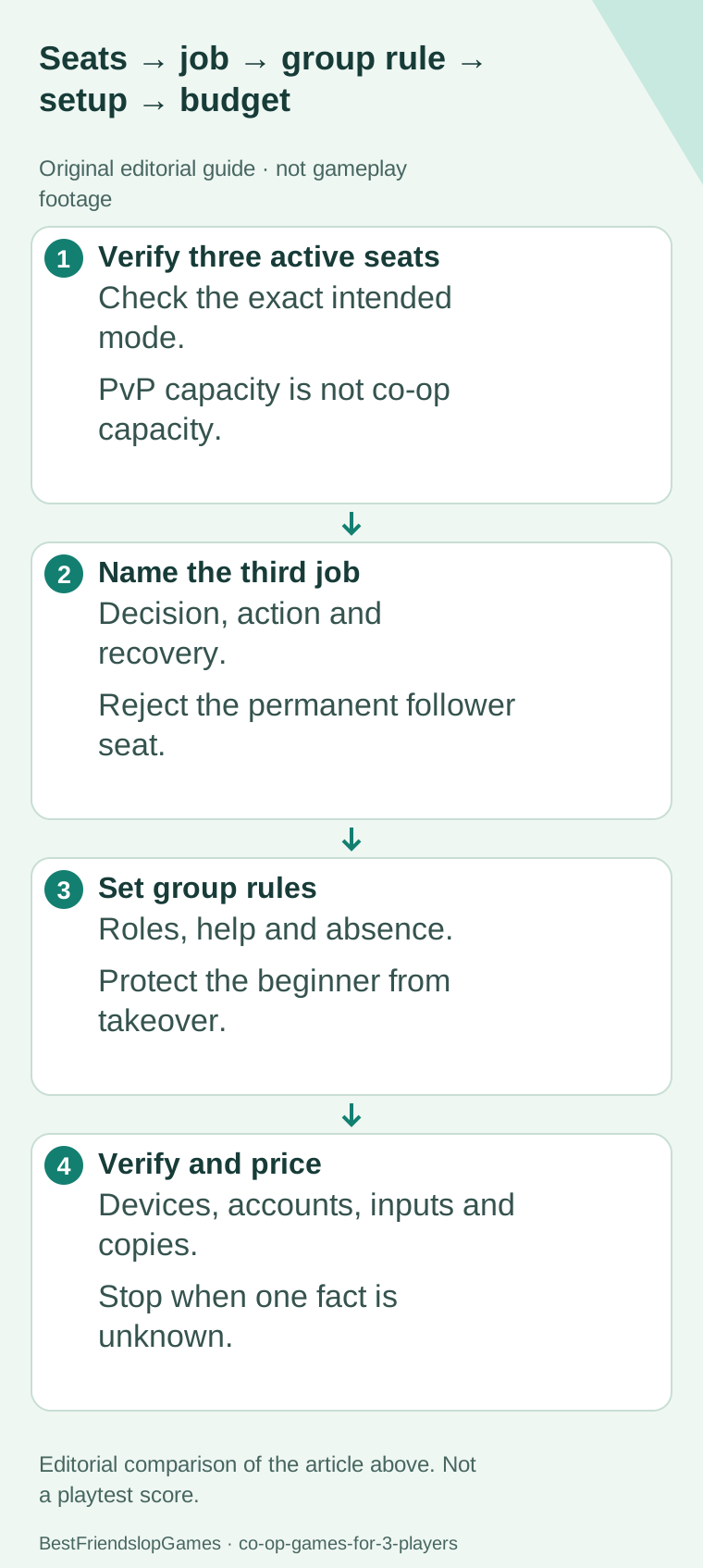
Five-step three-player check
1. Count three simultaneous active seats in the exact mode you intend to use. 2. Give the third player a decision, an action and a recovery responsibility. 3. Agree on class or hero choice, beginner help and a missing-person rule. 4. Verify devices, local or online mode, accounts, inputs and platform requirements. 5. Recheck the exact edition and current price, then total only the missing copies.
Editorial rule: Save the five answers with the game name and date. Recheck the list after an update, platform change or fourth regular player. A recommendation is ready only when every person can describe both their job and their exit condition. If one answer remains uncertain, keep the title in research rather than turning uncertainty into a purchase.
Quick answers
What is the strongest native three-player online choice here?
Space Marine 2 has the clearest official native-trio evidence across Campaign, replayable PvE and three-player Siege, but it is online only and Operations restricts duplicate classes.
Which choice supports three people locally?
Trine 5 supports local and online play. Its Classic mode permits three players with one instance of each hero, and its official FAQ documents one keyboard plus controllers on PC.
Which is the lowest regular three-copy total in this comparison?
Ravenswatch is $74.97 for three new regular-price base-game copies before tax. It is online co-op for up to four, not an exact-three local game.
Which choice gives a beginner the clearest difficulty controls?
Trine 5 documents adaptive puzzle and combat difficulty, while Ravenswatch documents four difficulty levels and custom modes. Neither feature replaces the group’s responsibility to ask before giving help.
Can six or eight friends use these recommendations together?
Not in the cooperative arrangements verified here. Space Marine 2 lists six-versus-six competitive PvP, which is not six-player cooperative PvE. Use another officially verified game for a larger simultaneous co-op room.
Source check: Saber FAQ, Saber modes, Remnant II official site, Trine 5 Steam page, Trine 5 developer FAQ, Ravenswatch Steam page. Facts and regular US prices were checked October 31, 2026.