Funny Co Op Games: Choose What Creates the Laugh
The best funny co op games create different kinds of shared failure. Choose Human: Fall Flat for up to eight online players wrestling with physics, Overcooked! 2 for four-player kitchen handoff mistakes, Moving Out 2 for four people transporting awkward objects locally or online, or It Takes Two for a two-person campaign built around changing abilities and comic surprises. Pick the mechanism your friends can laugh at together, not the game with the loudest comedy label.
Official Steam records and US prices were checked October 29, 2026. This is a sourced comparison, not a claim of playtesting. “Funny” is treated as an editorial fit question; official sources establish activities, modes, player arrangements and price, not a guarantee that every group will laugh.
Decide what is allowed to go wrong
Physics can make a careful plan collapse. A timed kitchen can turn one missed handoff into a chain reaction. Moving furniture can produce arguments about doors and angles. A two-character story can use unequal abilities to surprise both players. These are not interchangeable forms of comedy, and each can become frustrating when the group expects a different social contract.
Editorial rule: Ask each player to choose one acceptable failure: awkward controls, time-pressure mistakes, obstructed teamwork or story surprises. Then ask for one unacceptable target: being shouted at, being left behind, losing long progress or becoming the recurring joke. A candidate is a fit only when its normal activity produces the accepted failure without repeatedly crossing the group's boundary. This separates laughing with a friend from designing an evening around one friend's discomfort.
Compare players, comedy mechanism and dated cost
Counts and modes come from the linked official Steam records. Four-entry totals assume four new PC copies. A local one-device arrangement may need fewer copies but additional controllers; Friend's Pass follows its own two-person conditions. Taxes, hardware, subscriptions and optional content are excluded.
| Game and official source | Documented cooperative arrangement | What can create the shared joke | US price checked Oct. 29 | Four new online entries |
|---|---|---|---|---|
| Human: Fall Flat | Solo or up to 8 online; shared/split-screen co-op also listed | Wobbly movement, object handling and multiple puzzle solutions | $19.99 | $79.96 |
| Overcooked! 2 | Up to 4 in couch co-op or online play | Orders, throws and moving kitchens disrupt a job chain | $24.99 | $99.96 |
| Moving Out 2 | Solo or up to 3 friends; local co-op and cross-play online multiplayer advertised | Awkward furniture, routes and coordinated carrying | $29.99 | $119.96 |
| It Takes Two | Built purely for 2; online or shared-screen co-op; eligible Friend's Pass partner | Changing paired abilities and comic set pieces | $39.99 owner entry; Friend's Pass install free | Not a four-person session |
The four-copy arithmetic is 4 × $19.99 = $79.96, 4 × $24.99 = $99.96 and 4 × $29.99 = $119.96. It Takes Two has exactly two active roles, so multiplying its price to four would manufacture a room the game does not support. Current sale events, bundles and other editions can change; this table keeps the base entries comparable.
Editorial rule: Filter by the intended room first, then the failure mechanism. An eight-person online maximum is useful only when the group wants physics puzzles. A four-person kitchen is useful only when players accept time pressure and verbal coordination. A two-person Friend's Pass arrangement is economical only for a pair. Capacity and humor both have to fit; neither can compensate for the other.
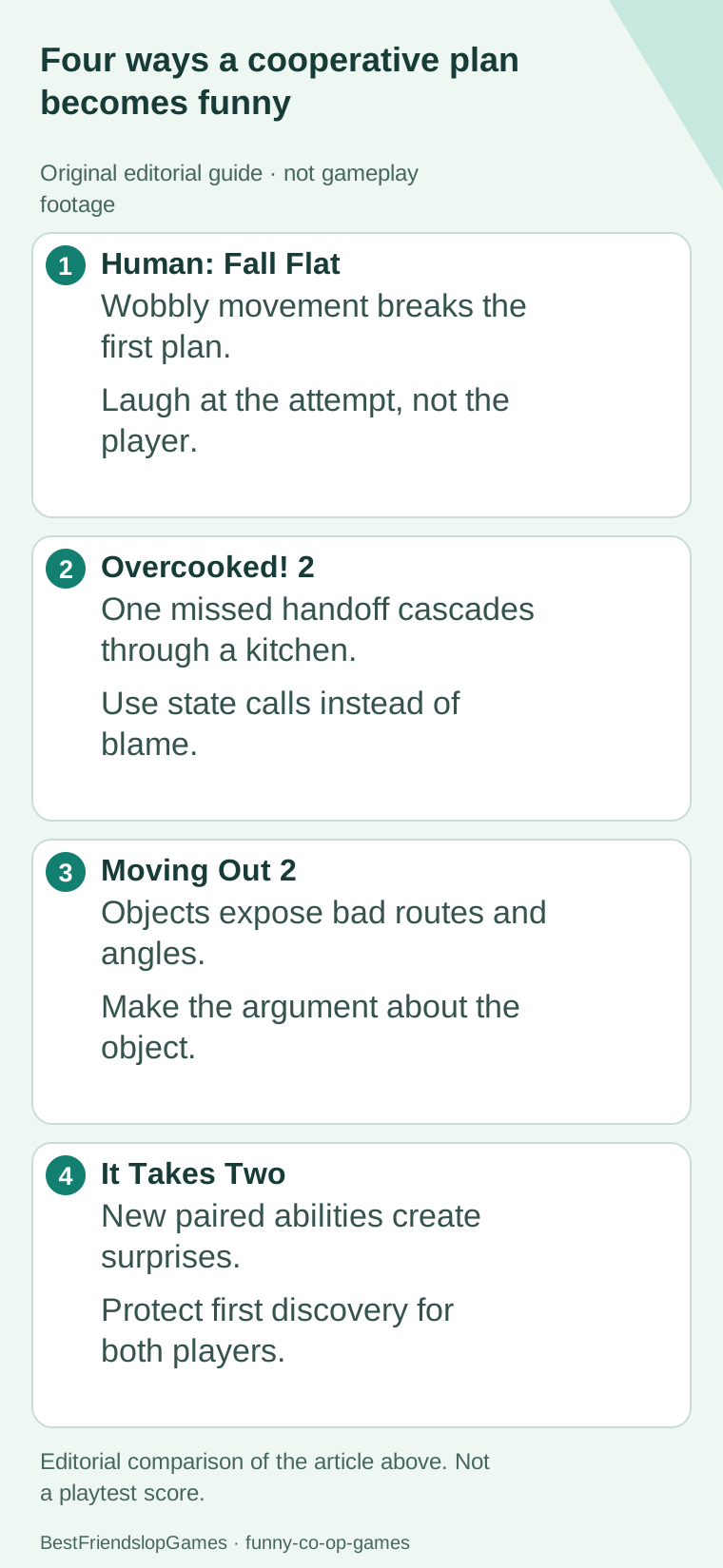
Human: Fall Flat: laugh at the attempt, not the slowest player
The official Human: Fall Flat page calls it a light-hearted platformer in floating dreamscapes and documents solo play or up to eight players online. Steam also lists shared/split-screen co-op. The game centers on physics, climbing, carrying and puzzles with multiple possible solutions. The checked US base price was $19.99.
Documented boundary: Up to eight online does not mean eight local seats on one PC, and Steam's shared-screen label does not state every local arrangement in the summary used here. Multiple solutions do not guarantee equal task ownership; one confident player can still take over a puzzle.
Editorial rule: Use a “first attempt belongs to the finder” rule. The person who spots an approach gets a short uninterrupted attempt before advice. If it fails, the group may add one suggestion at a time rather than grabbing control of the plan. Wobbly execution stays funny because failure belongs to an experiment, not to a person being judged. This is the strongest choice here when the group enjoys retelling how a plan failed more than optimizing a score.
Overcooked! 2: the joke lives in the handoff chain
Overcooked! 2's official description supports couch co-op or online play for up to four. Players prepare recipes while kitchens introduce moving platforms, teleporters and changing layouts. Throwing ingredients adds another handoff. The base game showed $24.99 in the October 29 US record.
Documented boundary: Local and online modes are both advertised, but that does not prove every mixed arrangement or platform combination. Up to four seats also does not make four independent jobs permanent; the kitchen can force players to switch or repeat tasks. Time pressure is part of the activity, not a cosmetic setting inferred away by calling the game casual.
Editorial rule: Ban blame sentences during the first two rounds. Use only state calls—“two plates ready,” “rice burning,” “left side blocked”—and assign a reset caller who can stop a broken plan between rounds. The comedy then comes from a visible system collapsing, not from somebody being publicly scored as the weak chef. Choose this when the group enjoys rapid recovery and short rematches. Reject it when raised voices stop feeling playful.
Moving Out 2: make the argument about the object
Moving Out 2 advertises solo play or work with up to three friends. Its official page describes local co-op and cross-play online multiplayer. The job is packing and shipping objects through unusual spaces; the base US Steam price checked on October 29 was $29.99.
Documented boundary: Cross-play wording is positive evidence for the advertised online feature, but the page checked here is not a compatibility matrix for every storefront and device. Four total workers do not guarantee that every object gives four meaningful grips. Local play also changes copy cost and controller requirements.
Editorial rule: Before lifting, let the group name the route and the “sacrifice corner”—the place where an object may be dropped without restarting the whole discussion. When the sofa jams, criticize the route, angle or timing instead of the player holding the wrong end. This game fits friends who find physical disagreement funny and can revise a plan. It is a weaker fit for a group that wants clear individual scores or dislikes repeating a carry.
It Takes Two: two people share the surprise
It Takes Two is officially built purely for two and supports online or shared-screen co-op. The Steam page describes connected character abilities, changing challenges and a comic story; an eligible Friend's Pass lets the invited partner join a game owner. The owner entry was $39.99 in the checked US record, and online play requires the documented EA account arrangement.
Documented boundary: This is a pair, not a party. A third friend cannot join the same chapter as another active character. The Friend's Pass conditions do not erase account setup, platform checks or the need for one person to own the game.
Editorial rule: Choose this when two players want the game to provide the joke and the next surprise, rather than generating comedy from a larger group's mistakes. Agree that both people see new mechanics before either searches for a solution. If one person routinely plays ahead or explains every set piece, the paired discovery disappears. Its strongest audience is a stable duo that wants to finish a campaign together; its hard limit is every group larger than two.
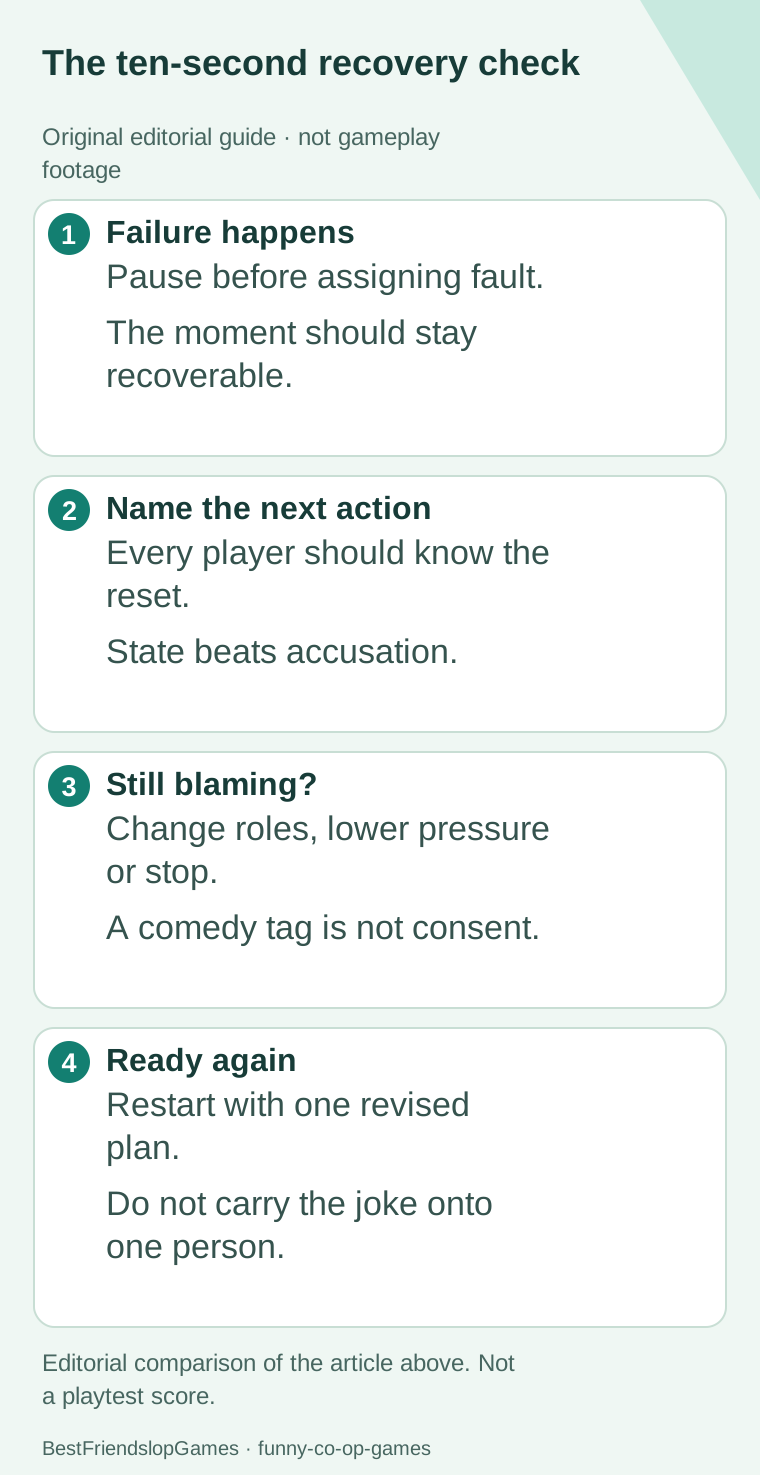
Separate a funny mistake from a social penalty
A funny mistake is short, visible and recoverable. A social penalty follows one person beyond the moment: they lose control, become the repeated target or are told they ruined the session. Physics games and timed work games can produce either outcome depending on the group's rules.
Editorial rule: Use a ten-second recovery check. After a failure, can every player name the next action within ten seconds without assigning fault? If yes, restart. If the conversation is still about who caused it, pause and change roles, lower the pressure where the game documents an option, or choose another activity. This is not a game feature claim; it is a group-safety rule that keeps the page's “funny” promise from becoming an excuse for hostility.
Match the room to the cause of laughter
- Choose Human: Fall Flat when the attempt itself—movement, carrying and improvised puzzle solutions—is the story.
- Choose Overcooked! 2 when short job-chain failures and recovery calls are the story.
- Choose Moving Out 2 when routes, angles and awkward shared objects are the story.
- Choose It Takes Two when a pair wants authored surprises and connected abilities to carry the story.
Editorial rule: Do not vote on titles first. Vote on these four causes, remove every game that cannot seat the group, then compare cost. This avoids the common failure where one player imagines relaxed physics while another imagines a timed score chase. The games can all look colorful and cooperative while asking for incompatible kinds of patience.
Budget the arrangement, not just the copies
Human: Fall Flat, Overcooked! 2 and Moving Out 2 can support four-person plans in the modes disclosed above, but online plans normally require a copy per new PC player. Local plans may use one copy and several compatible inputs. It Takes Two uses a separate one-owner/one-partner Friend's Pass model for its two-person room.
Editorial rule: Write two budgets: remote night and one-device night. Remote night lists missing copies, accounts and headsets. One-device night lists one compatible edition, controllers, display and seating. Do not mix the lowest copy count from local play with the convenience assumptions of online play. Recheck the exact store and mode before purchase, especially when a bundle or sale changes the displayed price.
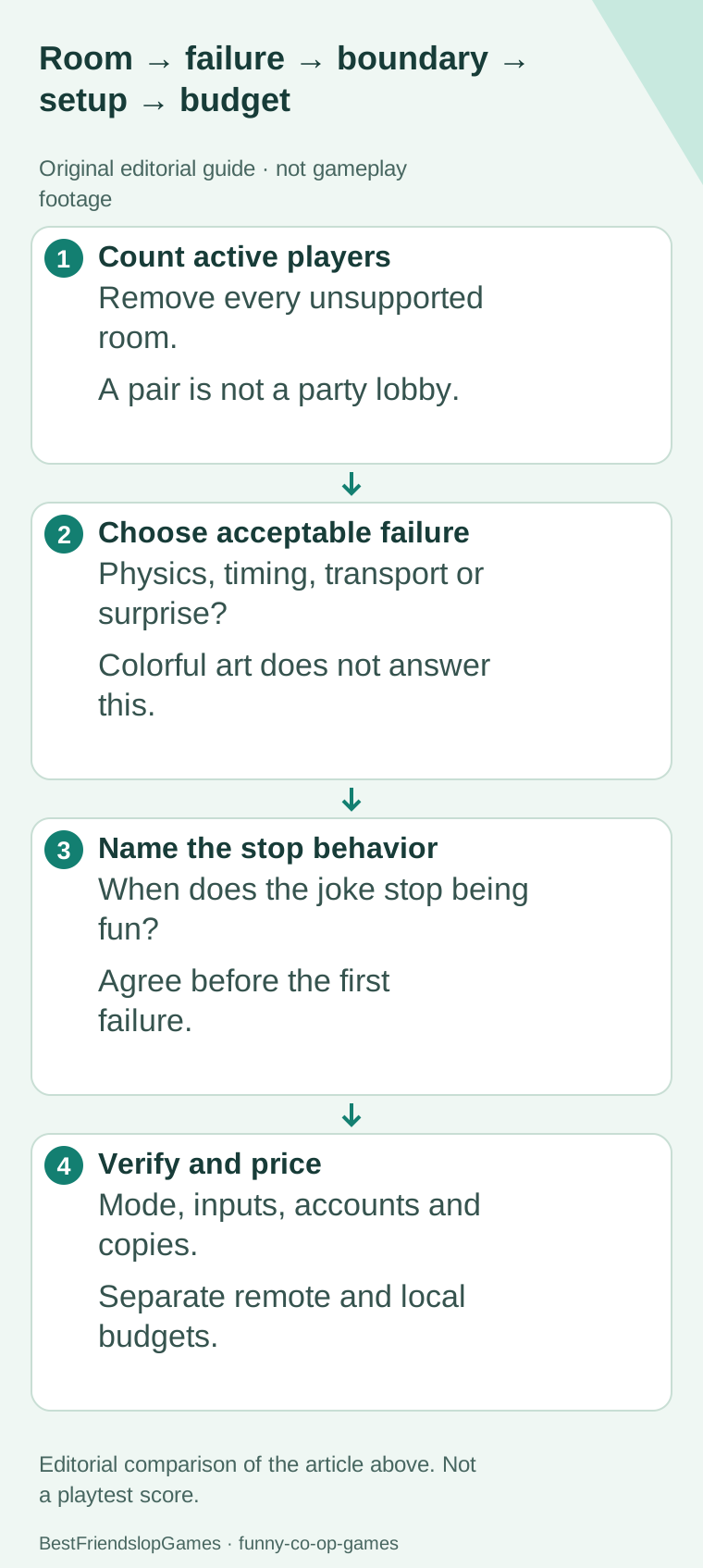
Five-step funny co-op check
- Count active players and reject every room that cannot seat them.
- Pick the acceptable failure: physics, time pressure, awkward transport or paired surprise.
- Name one behavior that would make the joke stop being fun.
- Verify exact mode, platform, account and controller needs with official sources.
- Price the actual remote or local arrangement and recheck at checkout.
Editorial rule: The stop rule matters as much as the shortlist. If the group cannot agree on acceptable failure, choose a calmer activity rather than using a comedy tag as permission to push through. If mode or platform support is undocumented, stop instead of borrowing an answer from a console edition, sequel or community workaround.
Quick questions
What funny co op game supports the largest checked online group?
Human: Fall Flat documents solo play or up to eight players online. Its humor comes from physics and multiple puzzle approaches, so a large capacity is useful only when that activity suits the group.
Which checked funny game is best for four players?
Overcooked! 2 is the direct four-person job-chain choice; Moving Out 2 is the four-person awkward-object choice. Human: Fall Flat also supports four inside its larger online maximum. Pick the failure mechanism before the price.
Which option works for exactly two people?
It Takes Two is built purely for two and offers an eligible Friend's Pass arrangement. It is a campaign commitment, not a flexible party lobby.
Does a funny tag guarantee the group will laugh?
No. Official sources can document activities, modes and seats. The group's tolerance for time pressure, physics mistakes and teasing determines whether those facts become comedy or frustration.
Sources and scope
The linked official Steam pages supplied advertised player arrangements, modes, activities, account notes and October 29, 2026 US price snapshots. GameSpot was reviewed for broad list structure and explicit player context; Stack Up for people-centered cooperative framing; Bits N' Pixels for concise list organization. They did not replace official product facts. Paragraphs marked “Editorial rule” are original group-decision methods derived from the disclosed constraints. The diagrams are original explanatory vectors, not gameplay screenshots.