Co Op Games for Couples: Pick the Commitment You Both Want
The best co op games for couples match the commitment both people want. Choose It Takes Two for an exactly two-player story built around connected abilities, Split Fiction for a newer exactly two-player action campaign with Friend's Pass, Stardew Valley for a shared farm that can continue at a self-directed pace, or A Way Out for an exactly two-player cinematic escape with mature content. Decide first whether you want a fixed pair, a continuing home or a single dramatic campaign; price comes after that agreement.
Official Steam records and US prices were checked October 30, 2026. This is a sourced comparison, not a playtest or relationship claim. A game marketed around a couple does not automatically fit every real couple, and a cooperative feature label does not establish universal cross-platform support, host transfer or a particular save arrangement.
Start with the relationship between sessions
Co op video games for couples can ask for very different promises. An exactly two-player campaign expects the same pair to return. A farm creates a continuing shared project. A cinematic story may be easier to finish in a few planned evenings but can carry a mature content boundary. A recommendation that starts with genre can hide the more important question: what happens between one session and the next?
Editorial rule: Complete one sentence together before buying: “If one of us wants to play and the other does not, we will ___.” The answer may be wait, play a separate save, do only maintenance, or choose another game. None is universally correct. The useful result is a rule that prevents one person from becoming the keeper of shared progress while the other feels pressured to attend. Reject any candidate for which the sentence produces resentment before the first install.
Compare the pair, the project and the dated entry price
The table uses the linked official Steam descriptions, feature labels and US prices. “Exactly two” means the game does not create a third active role in the same cooperative campaign. Local and online labels are kept separate from the number of copies a particular setup needs. Taxes, hardware, subscriptions, optional content and other storefronts are excluded.
| Game and official source | Documented arrangement | What the pair commits to | US price checked Oct. 30 | Base entry for the pair |
|---|---|---|---|---|
| It Takes Two | Built purely for 2; online and shared/split-screen co-op; eligible Friend's Pass; EA account for online play | A connected story campaign where both roles are required | $39.99 owner entry; Friend's Pass install free | $39.99 before tax under the eligible one-owner arrangement |
| Split Fiction | Exactly 2 cooperative roles; online and shared/split-screen co-op; Friend's Pass; cross-platform multiplayer listed | A fast-changing action campaign with paired mechanics | $49.99 owner entry; Friend's Pass install free | $49.99 before tax under the eligible one-owner arrangement |
| Stardew Valley | Online, LAN and shared/split-screen co-op listed; single-player also supported | A continuing farm, schedule and resource plan | $14.99 per new PC copy | $29.98 for two new online PC copies; one local setup may use one copy subject to verified inputs |
| A Way Out | Must be played with 2; online and shared/split-screen co-op; Remote Play Together; EA account | A cinematic escape campaign with two fixed characters | $29.99 | $29.99 for the verified one-copy Remote Play Together arrangement |
The arithmetic is 2 × $14.99 = $29.98. The other rows use an official one-owner invitation or Remote Play Together arrangement disclosed on their pages; that lowers copy cost but does not remove account, platform, controller, internet or eligibility checks. Recheck the exact edition and current store price before purchase.
Editorial rule: Filter in this order: content boundary, simultaneous seats, session commitment, setup, then cost. A cheap game fails when one person will not accept its content or continuity. A one-owner pass fails when the intended platform arrangement is not eligible. Price only the rows that survive those gates, and keep the rejected reason visible so a discount does not reopen a decision the couple already made.
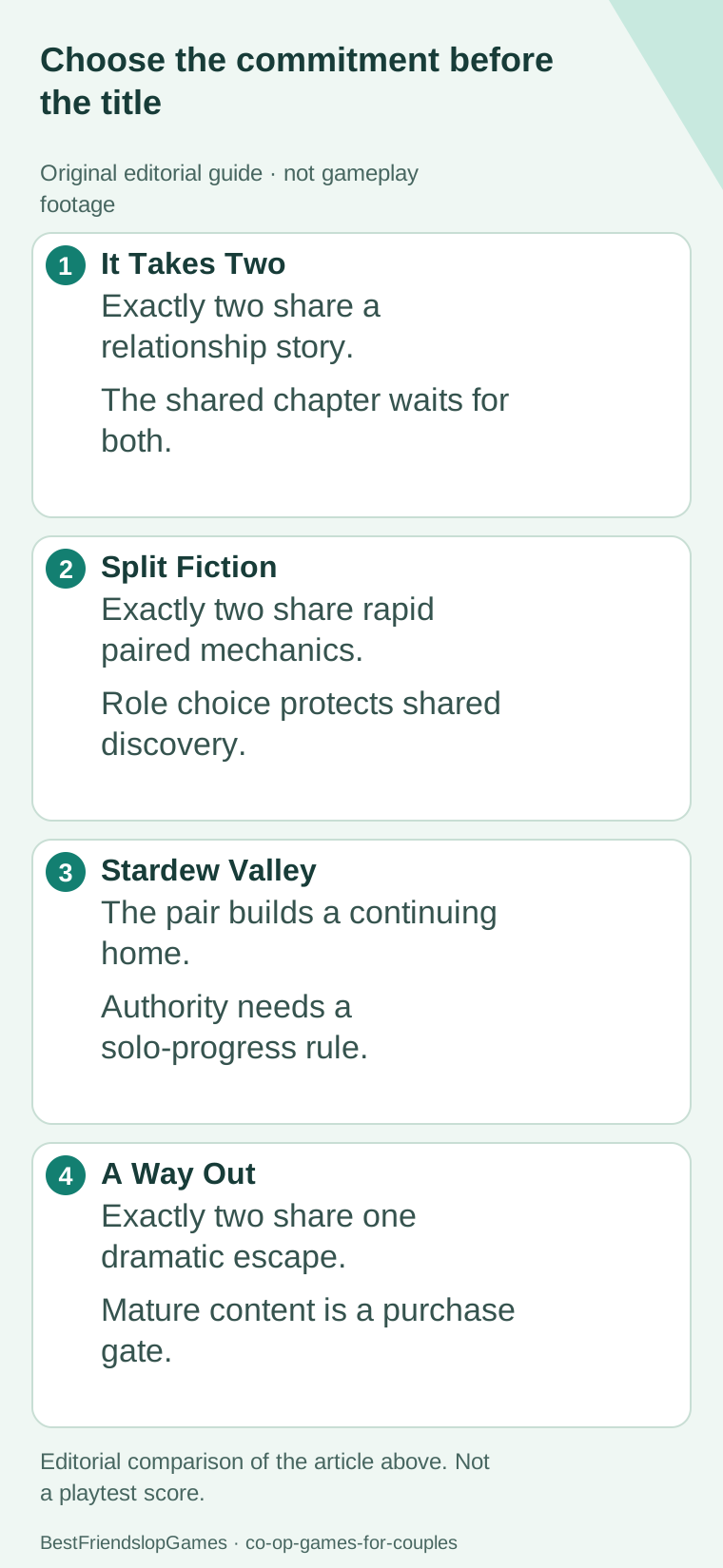
It Takes Two: choose a story that waits for both people
It Takes Two describes itself as created purely for cooperative play and built for two. Cody and May receive connected abilities and face changing challenges. Steam lists online and shared/split-screen co-op, and the official page offers Friend's Pass for an eligible invited partner. The page also states an EA account requirement for online play. The checked owner entry was $39.99.
Documented boundary: The story centers on a couple trying to repair a fractured relationship. That theme is not neutral background for every player, and the exact two-role structure does not support adding another active friend. Friend's Pass is an entry arrangement, not proof that every platform combination connects.
Editorial rule: Use this when both people want the same story to belong to the pair. Before starting, agree that neither person advances the shared chapter alone and that either may stop a scene whose relationship theme feels too close to a real disagreement. The game supplies forced cooperation; the couple still supplies permission to pause. This protects the strongest fit—two interdependent roles—without treating the story's subject as free counseling.
Split Fiction: choose constant novelty without adding a third seat
Split Fiction is an exactly two-player cooperative adventure about two writers moving through science-fiction and fantasy worlds. Steam lists online and shared/split-screen co-op, cross-platform multiplayer, Remote Play Together and a Friend's Pass install. The checked owner price was $49.99. Its campaign changes settings and mechanics while keeping the same two active roles.
Documented boundary: Cross-platform multiplayer is positive official evidence, but the exact Friend's Pass and account process still needs verification for the two intended devices. The page's rapid mechanical changes do not guarantee equal comfort with every camera, action or timing challenge. Two seats establish capacity, not equal confidence.
Editorial rule: Give the less-confident player first refusal on role choice whenever the game presents different abilities. After a failed section, ask whether the problem was understanding, execution or camera comfort before repeating it. Advice is useful only after the controlling player asks for it. This makes novelty a shared discovery instead of a sequence where one person solves and the other follows instructions.
Stardew Valley: choose a shared home with an ownership plan
Stardew Valley's Steam record lists single-player, online co-op, LAN co-op and shared/split-screen co-op. The work includes farming, fishing, mining, crafting and relationships inside a continuing calendar. The checked US PC price was $14.99 per copy, making two new online copies $29.98 before tax. A verified local setup may use one copy, but compatible inputs and the exact local arrangement still need checking.
Documented boundary: A flexible life simulation can create more ownership questions than a linear campaign. The official feature labels do not decide who controls the farm, which tasks are shared or whether either person may change the world alone. Single-player support does not automatically make unilateral progress socially acceptable on the couple's shared save.
Editorial rule: Divide authority, not chores. Name three decisions that require both people—major spending, layout changes and the next shared objective—and three areas each person may handle independently. Then set a solo-play boundary for the shared save. This avoids turning one partner into a manager assigning daily labor while the other becomes an assistant inside somebody else's farm.
A Way Out: choose one dramatic campaign and check the content first
A Way Out is an exclusively cooperative adventure built around Leo and Vincent, two prisoners working toward escape. Its official page says the experience must be played with two players and lists online and shared/split-screen co-op plus Remote Play Together. It requires an EA account and carries mature-content notices. The checked regular US price was $29.99.
Documented boundary: The crime story includes intense violence, blood, strong language, sexual content and nudity in its ESRB disclosures. Exactly two players still means no optional third role, and the fixed characters may not divide actions or screen attention evenly in every scene. Remote Play Together does not remove controller, network or account preparation.
Editorial rule: Treat content consent as a pre-purchase gate, not a conversation after a scene begins. Each person may name a hard stop without defending it. If the content is acceptable, decide who will control each character by preference rather than by assumed experience. Choose this for a pair that wants one bounded dramatic project; reject it when either person wants a gentler shared space or independent progress.
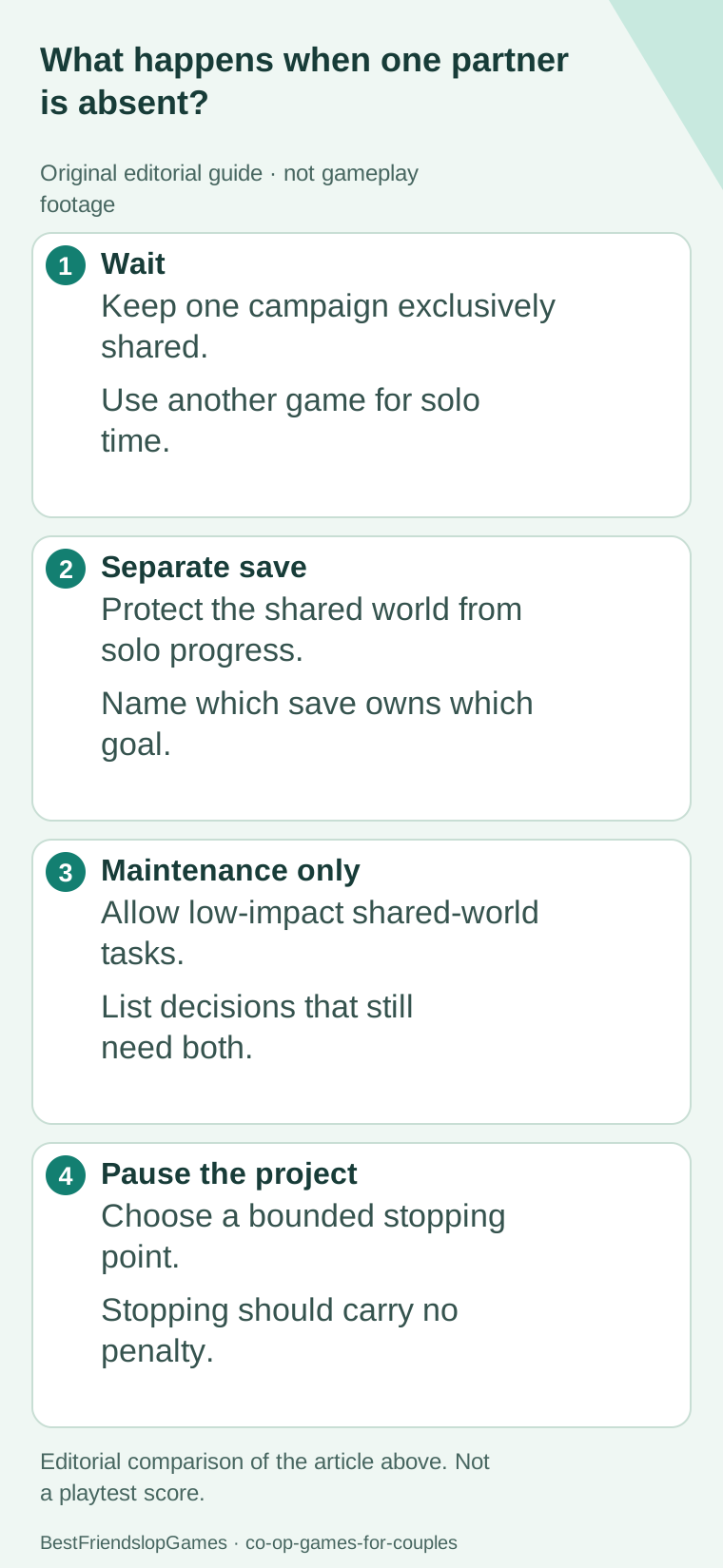
Use a three-night commitment test
A couple can like the same title and still want different rhythms. One person may want a campaign that waits. The other may want a world they can enter alone. A first-session impression cannot answer the continuity question, because the social cost appears when schedules diverge.
Editorial rule: Plan three nights before buying: the first establishes controls and comfort, the second tests returning to shared context, and the third tests a minor disagreement about role or objective. Define a short exit point for every night. The test is successful when both people can stop without punishment and resume without one person conducting a briefing. This is an editorial planning method, not a claimed game feature.
Separate help from takeover
Cooperative games expose differences in puzzle speed, camera control, route memory and tolerance for repeated failure. Those differences become harmful when the quicker player treats efficiency as the pair's only goal. They become useful when the game lets each person own a decision and request help explicitly.
Editorial rule: Use a two-question help protocol: “Do you want a hint or more time?” and “Do you want me to demonstrate or describe?” Silence means more time, not permission to take over. Rotate who speaks first after a failure. This keeps advice reversible and prevents the experienced player from turning an exactly two-player game into one player plus a controller holder.
Price local night and remote night separately
One-device and two-device arrangements have different real costs. Local play may need one copy and compatible controllers. Remote play may need two owned copies, or one owner plus an eligible pass, as well as accounts, internet and separate hardware. A store badge alone does not choose the cheaper working room.
Editorial rule: Write two budgets. Local night lists the exact edition, one display, compatible inputs and seating. Remote night lists each device, account, missing copy or pass, headset and online-service requirement. Do not combine the one-copy price from local play with the convenience assumptions of two independent online machines. Stop when one required compatibility fact remains unknown.
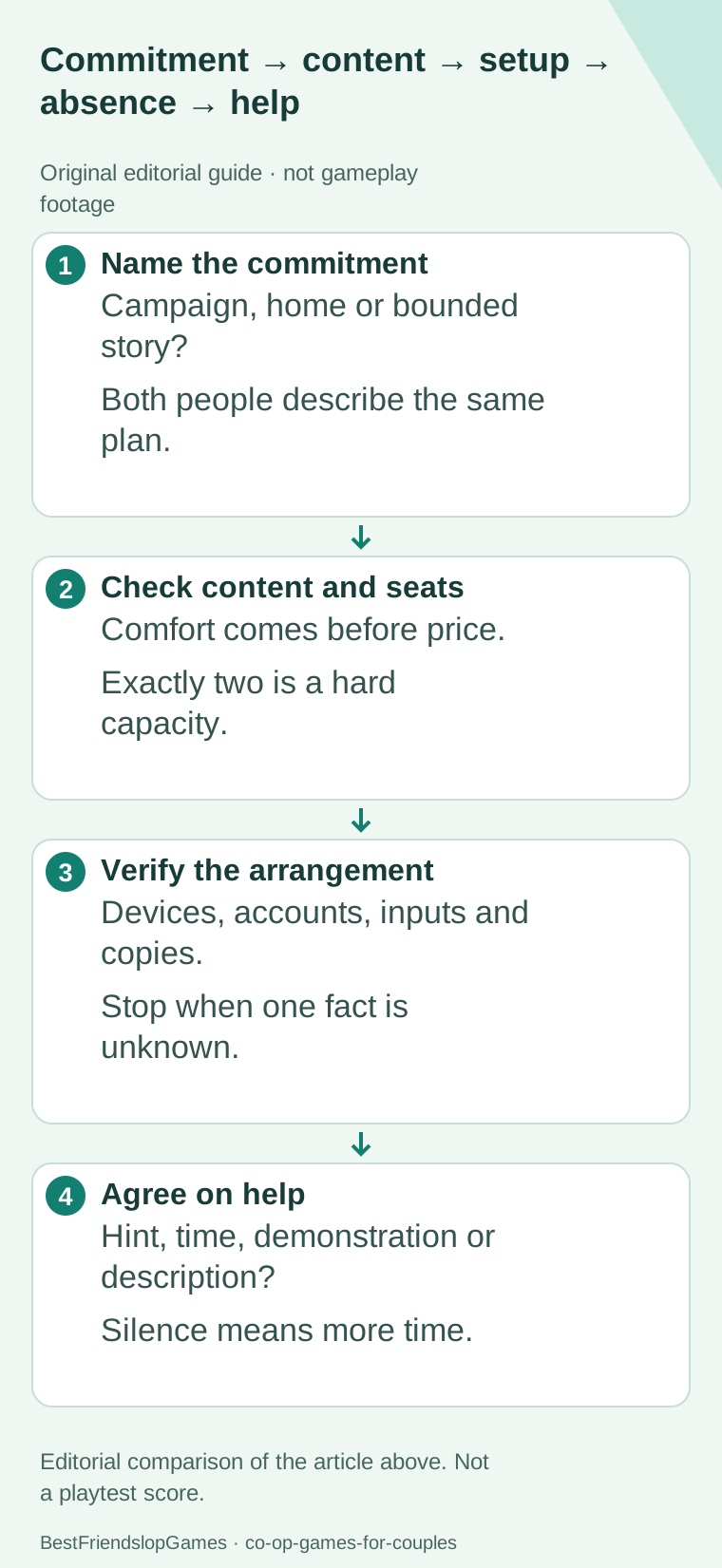
Five-step couples co-op check
- Agree on the shared commitment: fixed campaign, continuing home or bounded story.
- Check content boundaries before comparing price or popularity.
- Verify exactly how the two intended devices, accounts and inputs connect.
- Decide what either person may do when the other is absent.
- Set a help protocol and a no-penalty stop point before the first session.
Editorial rule: The best choice is the first game that passes all five checks, not the game with the broadest reputation. Record the agreement in one message so it can be revised without arguing about memory. Recheck the official store at checkout because prices and technical requirements can change. If both people cannot describe the same plan, postpone the purchase rather than hoping the game will negotiate for them.
Quick answers
Which checked game is built most directly around a couple? It Takes Two is officially built purely for two and its story centers on Cody and May, but the relationship theme should be treated as a content choice rather than automatic fit.
Which checked game gives the pair the most control over pace and ownership? Stardew Valley supports a continuing shared project and multiple cooperative modes, but the couple must make its own rules for solo progress and shared decisions.
Can one purchase cover both people? The official pages document eligible Friend's Pass arrangements for It Takes Two and Split Fiction, and Remote Play Together for A Way Out. Verify the exact platforms, accounts and devices before relying on one purchase. Stardew Valley's two-copy online total is $29.98 at the checked price; a local arrangement may differ.
Are these all suitable for every couple? No. A Way Out has mature-content disclosures, It Takes Two uses a relationship-repair story, and action or timing demands differ. Player count proves seats, not comfort.
Sources and prices were checked October 30, 2026. Store terms, sales and technical requirements can change after that date.