Games Like Escape the Backrooms: Four Co-op Alternatives by What Changes
The best games like Escape the Backrooms are Backrooms: Escape Together if your group wants the same liminal-horror premise with procedurally regenerated routes, Inside the Backrooms if four players want denser puzzle work, Labyrinthine if up to eight players want both a story and repeatable generated mazes, and The Backrooms: Survival if up to ten players want survival needs, crafting and combat. All four keep online cooperative exploration under threat, but each replaces a different part of Escape the Backrooms. Pick the change your group actually wants before comparing price.
Official descriptions, Windows Steam modes and US prices were checked October 25, 2026. This is a sourced comparison, not a playtest or a promise that another platform edition has identical features. Return to the Best Friendslop Games directory for other shared activities.
Start with the part of Escape the Backrooms you want to keep
Escape the Backrooms currently describes a one-to-four-player horror exploration game with more than 30 levels. Every teammate must reach the exit alive, entities have different survival rules, and proximity voice can attract danger. Its Windows Steam base price was $9.99 in this check. Those details create three separate attractions: touring many recognizable levels, learning how a level and its entities work, and keeping the whole group together long enough to leave.
A recent public question asked which Backrooms game is most engaging for two people because the store contains many choices. Another Steam discussion asks which game has the most players in one lobby and what happens after death. These are individual questions, not search-volume measurements or technical evidence. They reveal why a title-only list is insufficient: two buyers may use “like Escape the Backrooms” to mean the setting, the escape rules, the party size, or the way another attempt changes.
Editorial choice: Ask every player to finish one sentence: “The part we want again is ___.” If the answer is discovering many named levels, a shorter but more variable game may disappoint. If the answer is being lost together, a generated layout may matter more than a long fixed route. If the answer is solving mechanisms, count the puzzle work rather than the number of yellow hallways. If the answer is surviving with a larger group, reject every four-seat option before debating atmosphere. This single sentence prevents a familiar wall texture from hiding a different cooperative job.
Compare the route, party and new responsibility
The table uses the current Windows Steam records only. “Online co-op” is not evidence of shared-screen play. Prices are base-game snapshots before tax; Early Access can change content and price. The final column is an editorial comparison derived from the documented mechanics, not an official similarity score.
| Game and official source | Documented cooperative arrangement | Route and shared job | What changes most | US price checked Oct. 25 | Four new copies |
|---|---|---|---|---|---|
| Escape the Backrooms — reference | 1–4; online co-op | 30+ levels; learn entities; get every teammate to the exit | Reference game | $9.99 | $39.96 |
| Backrooms: Escape Together | 1–6; online co-op; Early Access | 11 procedurally generated levels; proximity voice; changing layouts, items and encounters | Fewer advertised levels, but the same level can regenerate | $9.99 | $39.96 |
| Inside the Backrooms | Up to 4; online co-op; Early Access | Five large levels plus two secret mini-levels; puzzles, supplies and entity rules | Smaller stated level set; stronger puzzle emphasis and changing solutions | $6.99 | $27.96 |
| Labyrinthine | 1–8; online co-op | Story mode plus procedurally generated case files; puzzles, items and monster rules | Backrooms lore gives way to hedge mazes and investigations | $9.99 | $39.96 |
| The Backrooms: Survival | Up to 10; online co-op; cross-platform multiplayer with Nintendo Switch listed | Random levels, needs, loot, crafting and combat across four modes | Escape exploration becomes a roguelike survival system | $9.99 | $39.96 |
The reference row is included so the compromises remain visible. Four-copy totals equal four newly required copies multiplied by the dated unit price. They exclude tax, hardware, subscriptions and optional content. A larger party needs a fresh calculation and a candidate whose documented cap actually fits.
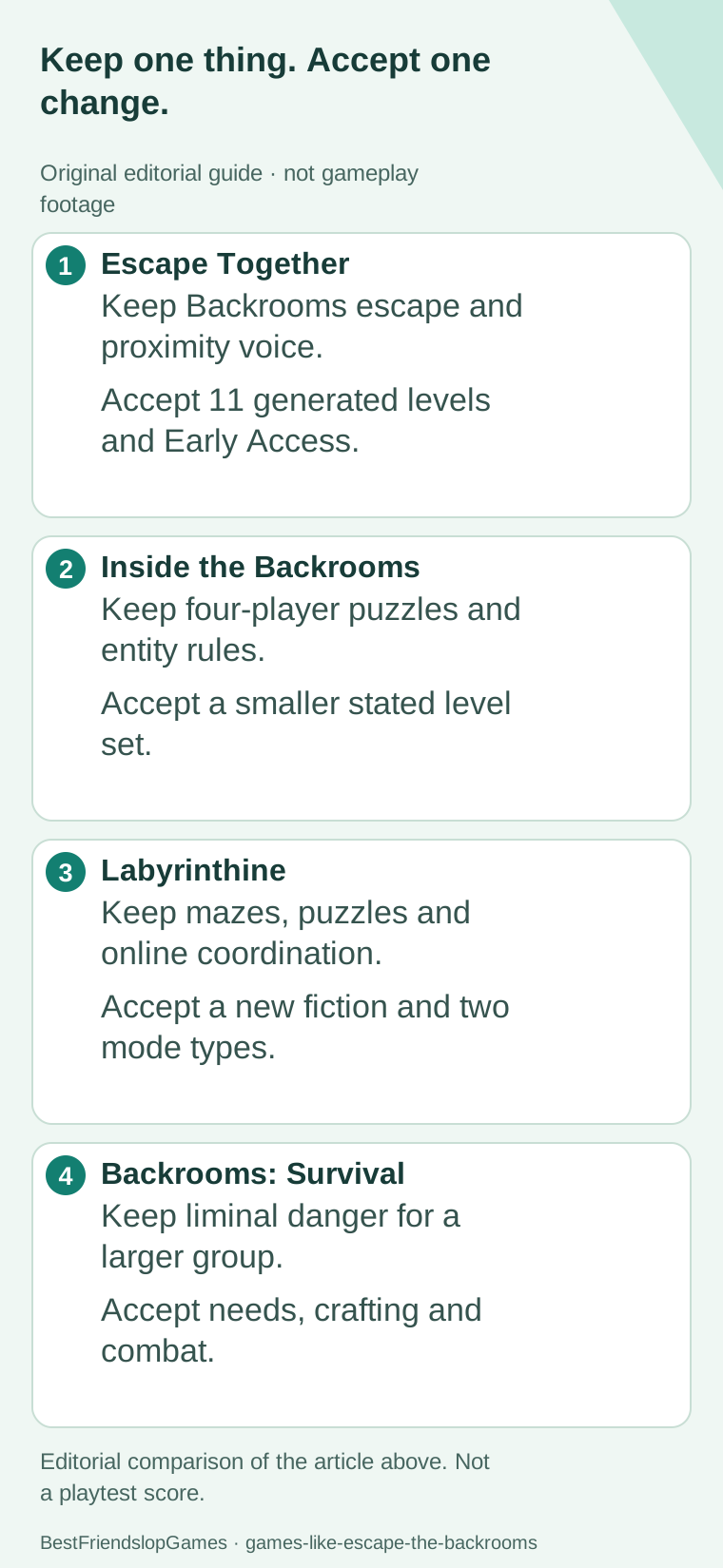
Backrooms: Escape Together: keep the setting and make the route less repeatable
Documented fit: The official page supports one to six people online. It describes 11 procedurally generated levels, proximity voice chat, distinct entity behavior, and changing layouts, item spawns and encounters. It remains in Early Access. The current Windows Steam price is $9.99.
Documented boundary: Escape the Backrooms advertises more than 30 levels, while Escape Together advertises 11 generated levels. The second number does not prove less playtime, higher replay value or better quality. It establishes a different content structure. Both use the Backrooms premise, entities and cooperative escape, but an advertised level count and a regeneration system are not interchangeable units.
Editorial choice: Choose this branch when your group wants recognizable Backrooms rules but dislikes knowing that the remembered route will always solve the next attempt. Generated layouts shift the useful conversation from “follow me; I know the path” toward “report what appeared this time.” The cost is that a group seeking a long tour through many named lore locations may value Escape the Backrooms' broader advertised catalogue more. Before buying, decide whether repeat variation or breadth of distinct levels is the real priority. Do not describe 11 generated levels as automatically more or less content than 30-plus listed levels.
Inside the Backrooms: replace route breadth with concentrated puzzle work
Documented fit: The official page supports online co-op for up to four people. It describes five large levels and two secret mini-levels, supplies to manage, entities with different attack behavior, and puzzles whose solutions change in each new game. It remains in Early Access. The current Windows Steam price is $6.99.
Documented boundary: This option does not fit a five- or six-person group under the documented cap. Its official description foregrounds puzzles, items, anxiety, stamina and limited inventory. That is a denser set of moment-to-moment systems than merely finding a door, but it is not proof of greater difficulty or a longer session.
Editorial choice: Put Inside the Backrooms first only when four-or-fewer friends want to stop, exchange clues and manipulate mechanisms rather than primarily tour a large catalogue of locations. Changing a puzzle solution can preserve discussion after somebody remembers the room, but it does not erase all prior knowledge of the mechanism. Agree on a hint rule before starting: a returning player can explain controls and entity warnings without immediately announcing every solution. That keeps the cooperative reasoning available to newcomers. If the group wants six seats or a broad visual tour, the lower price should not overrule those missing requirements.
Labyrinthine: trade Backrooms lore for two kinds of maze night
Documented fit: Labyrinthine supports one to eight online players. Its story mode follows a set mystery through a hedge maze, while case files use procedurally generated mazes with escalating difficulty. The official page also lists puzzles, items, distinct monster mechanics, more than 30 monsters and 19 maze types unlocked through its leveling system. The current Windows Steam price is $9.99.
Documented boundary: This is a liminal maze and monster alternative, not another Backrooms-lore catalogue. It preserves being lost, learning threats and coordinating an escape, but changes the fiction and adds a choice between authored progression and generated investigations. The store does not list shared/split-screen co-op in the checked categories.
Editorial choice: Choose Labyrinthine when the group is divided between people who want a campaign path and people who want repeatable generated runs. Use story mode for a shared sequence, then treat case files as a separate evening type rather than assuming progress and expectations transfer unchanged. Its eight-player cap solves a real attendance problem that a four-player title cannot, but more seats can also make clues and movement harder to coordinate. Assign one person to repeat discoveries and another to confirm the group is together; that is an organizational suggestion, not a claim about a required in-game role.
The Backrooms: Survival: make hunger, loot and crafting part of the escape
Documented fit: The official page lists play for up to ten players, online co-op and cross-platform multiplayer with Nintendo Switch. It describes randomized levels, items and events, proximity voice, hunger, thirst and sanity, crafting, equipment, combat, professions and four modes: permadeath, adventure, sandbox and peaceful exploration. The current Windows Steam price is $9.99.
Documented boundary: These survival and roguelike systems materially change the shared job. The group is no longer only reading a level and reaching an exit; it may gather food, choose equipment, craft tools and fight. “Cross-platform” here is kept to the specific Nintendo Switch relationship stated by the official page, not expanded to every console.
Editorial choice: Pick this branch when a large group wants decisions between rooms, not only decisions about rooms. Hunger, inventory, professions and equipment turn the run into a resource plan. That can give ten people more responsibilities, but it can also bury the simple liminal-exploration appeal under survival maintenance. Ask whether the quietest player wants a defined supply or navigation responsibility, and whether the group accepts losing progress under a permadeath rule. If not, inspect adventure, sandbox or peaceful mode before purchase rather than assuming every mode uses the same consequence structure.
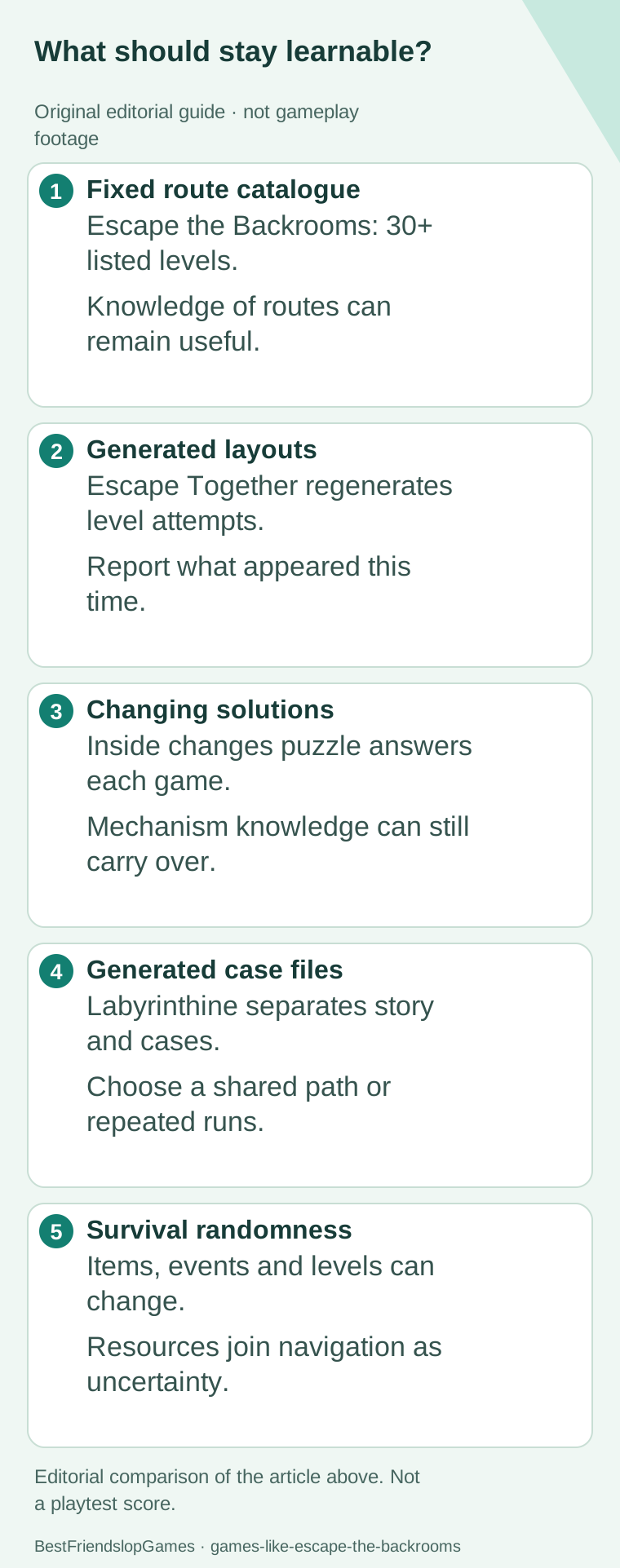
Separate fixed knowledge from changing knowledge
Escape the Backrooms uses many distinct levels and entity rules. The alternatives distribute uncertainty differently: Escape Together regenerates layouts, Inside changes puzzle solutions, Labyrinthine offers generated case files beside a story, and The Backrooms: Survival randomizes levels, items and events. These are four different answers to “will our previous knowledge solve the next run?”
Editorial choice: Create two columns in the group chat: “knowledge we want to earn” and “knowledge we want the game to scramble.” Put entity behavior, puzzle logic, route layout, item locations and resource recipes into the appropriate column. A group that enjoys mastering entity reactions may dislike a system that changes too many other variables at once. Another group may consider a remembered route a spoiler to its own fun. The useful comparison is not a vague replayability score; it is which knowledge should remain valuable after tonight and which knowledge should be made uncertain again.
Count attendance before pricing the night
For four people needing new Windows Steam copies, Inside the Backrooms totals $27.96 at the checked price. Escape the Backrooms, Backrooms: Escape Together, Labyrinthine and The Backrooms: Survival each total $39.96. For six people, the documented caps eliminate Escape the Backrooms and Inside the Backrooms; six new copies of each remaining $9.99 option total $59.94.
Editorial choice: Treat party fit as a pass/fail gate and price as the next filter. A $27.96 four-copy option is not cheaper for six people if two cannot join. Conversely, a ten-player maximum does not mean the game needs ten people or that every group size feels identical. Count the friends who will actually install and attend, reject unsupported arrangements, then multiply only the copies still needed. If one person already owns a game, subtract that purchase rather than repeating a headline total. Recheck checkout prices because this dated arithmetic is not a promise about a later sale or regional store.
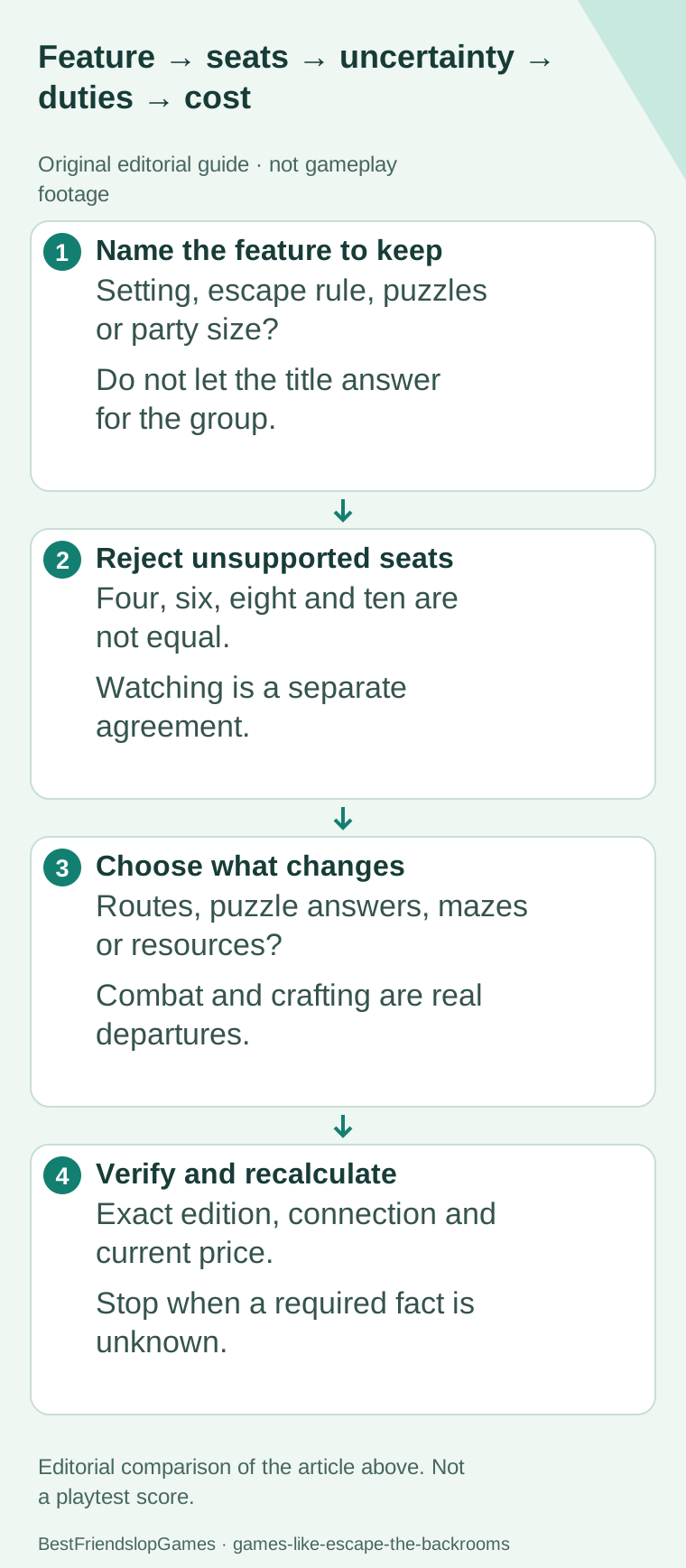
Use a five-step replacement check
- Name the one Escape the Backrooms feature the group refuses to lose.
- Count actual attendees and reject every smaller documented cap.
- Choose fixed routes, changing puzzle answers, generated mazes or full survival randomness.
- Decide whether crafting and combat are welcome responsibilities or unwanted overhead.
- Verify the exact platform arrangement and recalculate current copy cost before anyone buys.
Editorial choice: Stop when a required fact is still unknown. Do not convert an online-co-op badge into a couch-play promise, extend a Nintendo Switch cross-platform statement to unlisted consoles, or treat Early Access plans as shipped content. The honest recommendation can be “verify this edition first.” That answer is more useful than filling a missing cell with the behavior of another Backrooms game whose title looks similar. The number of near-identical names is precisely why the purchase link, exact developer page, player cap and current development state belong beside every recommendation.
Quick questions
Which option is closest in theme and online group play?
Backrooms: Escape Together keeps the Backrooms setting, online group escape, entity rules and proximity voice. Its documented difference is a smaller advertised set of procedurally generated levels and a six-player cap. “Closest” here is an editorial judgment from those facts, not a claim that the games feel identical.
Which option supports the largest checked group?
The Backrooms: Survival lists up to ten online players. Labyrinthine lists one to eight, Backrooms: Escape Together one to six, and Inside the Backrooms up to four. These are documented maximum arrangements, not recommended minimums.
Which option has the lowest four-copy base price in this snapshot?
Inside the Backrooms totals $27.96 for four new $6.99 copies. The other checked $9.99 titles total $39.96 for four. Tax, hardware, optional content and subscriptions are excluded.
Can these Windows Steam alternatives be played by four people on one screen?
The checked listings advertise online co-op and do not list shared/split-screen co-op. This article does not verify unofficial local-play tools or every console edition. Plan one supported device and copy per online participant unless the exact platform page says otherwise.
Sources and scope
The five linked official Steam records supplied the October 25, 2026 Windows modes, player counts, development status, descriptions and US price snapshots. GameSpot's 2025 review and 2026 Backrooms overview were read for structure and category boundaries, not reused as current technical evidence or personal experience. Stack Up's Abiotic Factor review and Bits N' Pixels' R.E.P.O. review were adjacent co-op-horror readings only; neither was represented as a direct Escape the Backrooms comparison. The public community questions document individual buying language, not demand, consensus or game facts. Paragraphs labelled “Editorial choice” are original decision rules inferred from the cited facts. The diagrams are original explanatory vectors, not gameplay screenshots.