Games Like Supermarket Together: Co-op Shop Jobs and a Muck Survival Branch
The best games like Supermarket Together are Grocery Store Simulator for a four-person grocery workflow, Retail Company Simulator for a four-person clothing store with contracts and staff, and Ale & Tale Tavern for up to six friends who want service work plus cooking, farming and exploration. If your real comparison is Muck, skip the shop rows: Valheim is the closer documented branch for a persistent survival world. Supermarket Together itself remains the only checked option here that combines a free base entry, up to 16 players and a supermarket job.
Official Steam records and US prices were checked October 27, 2026. This is a sourced comparison, not a playtest. Supermarket Together is the primary question; the lower-volume Muck variant is handled as a clearly separated survival branch inside this page rather than opened as another URL. Search-planning measurements stay in the internal editorial record instead of being presented as site-performance data.
Define the job before replacing the game
Supermarket Together is free to play and supports solo play or up to 16 online players. Its official description gives the crew a continuing supermarket: stock shelves, set up shop space, unlock franchises and perks, hire employees, catch shoplifters, clean, handle online packages and operate departments. More players also bring more demanding customers. That combination makes party size, work division and base-entry price part of the product—not details to hide below a list of names.
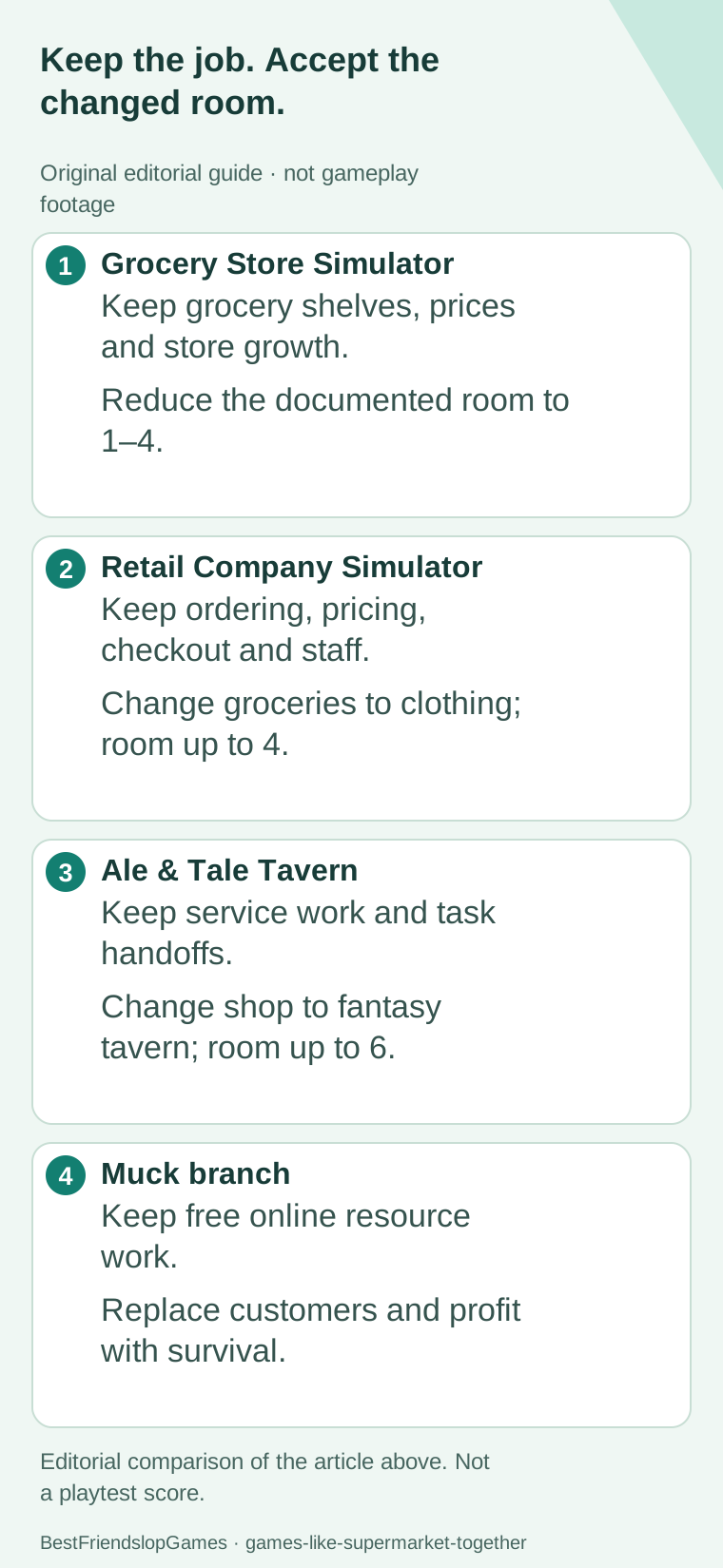
The nearest alternatives preserve different parts. Grocery Store Simulator keeps groceries and a four-person shop. Retail Company Simulator keeps ordering, pricing, cleaning, theft prevention and employee growth but changes the merchandise to clothing. Ale & Tale Tavern keeps customer service and divided chores while adding a fantasy world. Muck keeps free online cooperation and resource gathering but abandons the business shift for a survival roguelike. Similarity is therefore a set of retained jobs and accepted losses, not a screenshot resemblance.
Editorial choice: Write the sentence “we want to run a ___ together” before buying. Fill the blank with grocery store, retail shop, tavern or survival camp. Then assign one first-session responsibility to every intended player: purchasing, stocking, checkout, cleaning, cooking, gathering, building or defense. A candidate fails early if the documented group size cannot seat everyone or if its advertised work leaves half the crew waiting. This job-first test prevents a free price, a management tag or a first-person camera from hiding the actual change. It also exposes the Muck branch immediately: a group that writes “survival camp” is not looking for another cash register.
Compare players, work and dated entry cost
The table uses official Steam descriptions and feature labels. “Online co-op” does not prove local split screen, cross-platform support or a numeric cap that the page does not publish. Four-entry totals are arithmetic for four new PC players, not universal group budgets.
| Game and official source | Documented online arrangement | Shared work that remains | US price checked Oct. 27 | Four new entries |
|---|---|---|---|---|
| Supermarket Together — reference | Solo or up to 16 players; online co-op | Stocking, checkout, cleaning, security, packaging, manufacturing, expansion | Free to play | $0 base entry |
| Grocery Store Simulator | 1–4 players; online co-op | Stock shelves, set prices, hire staff, customize and expand a supermarket | $14.99 | $59.96 |
| Retail Company Simulator | Solo or up to 4 players; online co-op | Contracts, orders, unpacking, racks, pricing, checkout, cleaning and staff | $4.79 sale; $11.99 regular | $19.16 sale; $47.96 regular |
| Ale & Tale Tavern | Solo or up to 6 players; online co-op | Cook, serve, clean, grow, hunt, fish, craft and explore around a tavern | $14.99 | $59.96 |
| Muck — secondary branch | Online co-op; checked official page omits a numeric cap | Gather resources, find items, build a base and survive | Free to play | $0 base entry |
| Valheim — Muck-like branch | 1–10 players; online co-op | Explore, gather, build, fight and progress through a persistent Viking world | $29.99 | $119.96 |
The arithmetic is 4 × $14.99 = $59.96, 4 × $4.79 = $19.16, 4 × $11.99 = $47.96 and 4 × $29.99 = $119.96. Retail Company Simulator's checked sale price is temporary and its regular price stays visible. These totals exclude tax, hardware, subscriptions and optional purchases. Free base entry means no base-copy charge; it does not promise zero setup cost or equal value.
Editorial choice: Use two filters in order. First, reject any row whose documented online arrangement cannot hold the people who must play simultaneously. Second, calculate only the copies your group still needs. A six-person group has one fully documented shop-service option here, Ale & Tale Tavern; a 16-person plan points back to Supermarket Together rather than forcing four-player stores to imitate it. For four people, compare $0, $19.16 during the checked sale and $59.96 without converting price into a quality score. A cheaper replacement can still be wrong if the desired job is groceries and the row sells clothing or survival.
Grocery Store Simulator: keep the grocery aisle, reduce the crew to four
Documented fit: Grocery Store Simulator's official page describes a one-to-four-player cooperative supermarket. Friends stock shelves, set prices, hire staff, customize the store, expand the business and keep customers happy. Steam labels both single-player and online co-op. The checked US price is $14.99 per new copy.
Documented boundary: Four players is one quarter of Supermarket Together's advertised 16-player maximum. The $59.96 four-copy total is also a different entry structure from a free-to-play base game. The description supports grocery work and expansion, but it does not convert a four-person room into a large rotating crew. This page does not infer couch play or cross-platform support from the word multiplayer.
Editorial choice: Choose Grocery Store Simulator when the word “grocery” matters more than the crowd. Before launch, assign receiving, stocking, pricing and checkout; let staff hiring become the handoff from manual chores to management. Reject it if five or more people need simultaneous seats, because taking turns is a new social arrangement rather than a hidden fifth slot. Its strongest use is a stable three- or four-person crew that wants everyone close to the same inventory chain. Its clearest loss is scale: fewer people means less chaos, but also fewer idle roles to absorb when one player prefers to wander.
Retail Company Simulator: keep the workflow, change what the store sells
Documented fit: Retail Company Simulator advertises solo play or cooperative play for up to four. The official description lists brand contracts, computer orders, unpacking, product placement, price setting, cleaning, theft prevention, online orders, checkout, warehouse expansion and hired stockers or cashiers. The merchandise includes clothing such as shirts, jackets, shoes and hats. Steam labels online co-op.
Documented boundary: This is a retail-company substitute, not another supermarket. Four seats replace a maximum of 16, groceries become clothing, and the October 27 US sale price of $4.79 can return to the displayed $11.99 regular price. A four-copy sale total of $19.16 is evidence of today's checkout comparison, not a promise about tomorrow.
Editorial choice: Pick Retail Company Simulator when your group talks about the chain of work—order, receive, display, price, sell and restock—more than the food on the shelves. Give one person authority to place purchase orders and another authority to change prices; otherwise two independent optimizers can turn a shared shop into contradictory plans. Rotate those roles after one store expansion so the same player does not become permanent manager. This branch is especially useful for a four-person crew that wants a paid but currently inexpensive experiment. It is a weak fit for anyone whose favorite moment is a huge 16-person supermarket rush.
Ale & Tale Tavern: keep service work, open the doors to a fantasy world
Documented fit: Ale & Tale Tavern's official Steam page describes a cooperative first-person fantasy tavern simulator with cooking, serving, decorating, crafting, farming, fishing, hunting, exploration and quests. It supports solo play or cooperative parties of up to six. The checked US base price is $14.99, so four new copies cost $59.96 before tax.
Documented boundary: The shared workplace is a tavern, not a supermarket. Open-world activities and combat can pull players away from the service floor, while a six-person maximum still does not reproduce Supermarket Together's 16-player scale. Owl helpers can automate some tavern routine, but automation changes who has a live job rather than creating more human seats.
Editorial choice: Choose Ale & Tale Tavern when the group wants a home base but not an entire evening behind one counter. Divide the first hour into two linked teams: service handles orders, cooking and cleaning while supply handles gathering, farming or fishing. Swap after a rush so exploration does not become the privilege of the loudest friend. That structure preserves the comic handoffs of a busy shop while using the fantasy world as a pressure-release valve. Reject it when the group wants a pure retail economy, or when seven or more players need to work in the same documented session.
Games like Muck belong in a separate lane inside this page
Muck is a free survival roguelike. Its official description centers on collecting resources, finding items, building a base and surviving as long as possible; Steam lists online co-op and online PvP but the checked official page does not state a numeric player cap. Those facts make Muck a poor shop substitute and a useful branch for readers whose “together” requirement really means free resource work under danger.
Valheim is the documented persistent-world answer in this branch: its official page describes one-to-ten-player collaborative exploration and survival, with building, battle and progression in a procedurally generated Viking afterlife. Its checked US price is $29.99, or $119.96 for four new copies. The existing games like Valheim comparison covers that family in depth; this subsection does not create a second Valheim page.
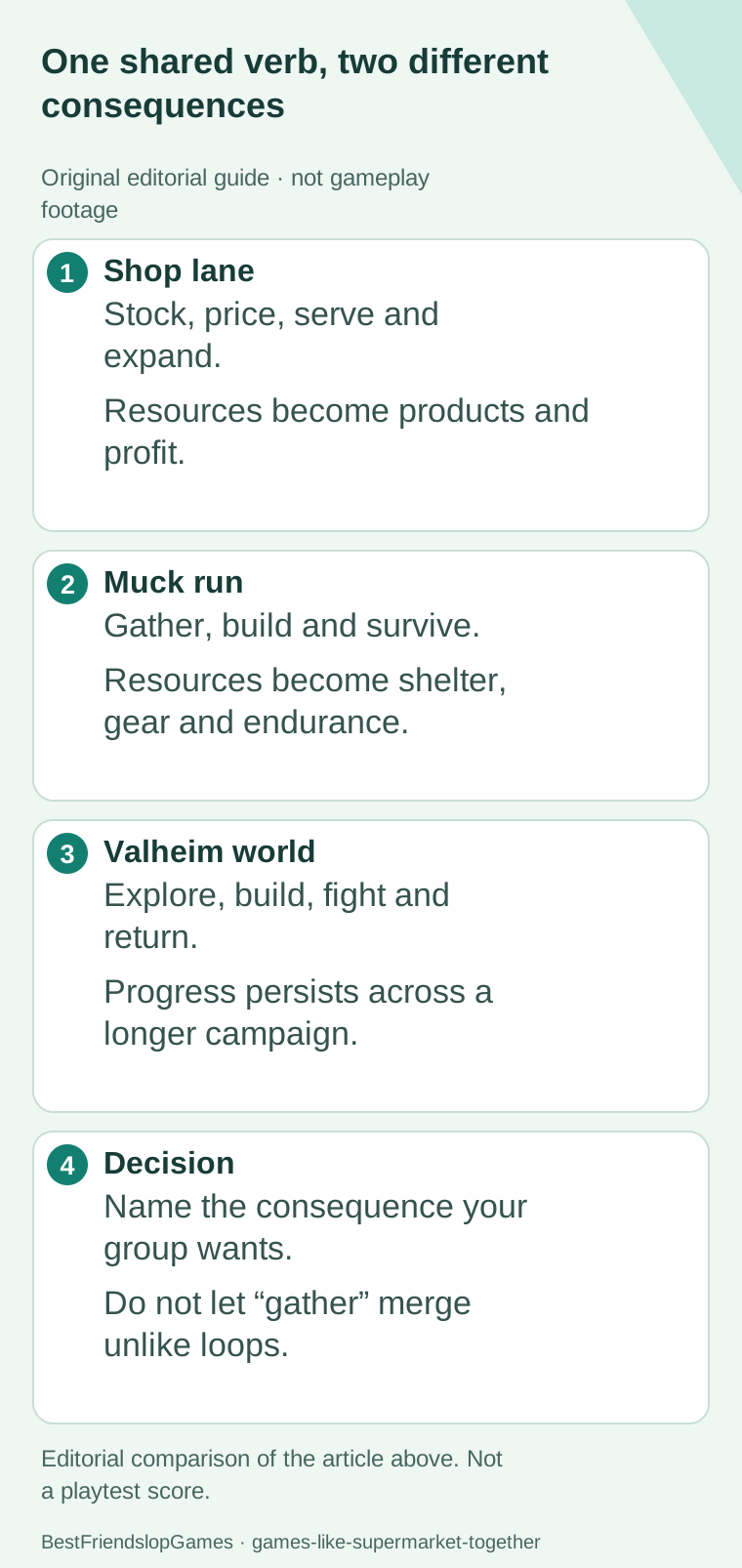
Editorial choice: Treat Muck as a reset-tolerance question. Choose it when a free run can end, failure can erase immediate plans, and gathering exists to prepare for the next danger. Choose Valheim when the group wants building and progression to accumulate in a world that can anchor future sessions. Do not recommend either merely because players gather wood in both. A supermarket shift produces money, stock and expansion through customer service; a survival run converts resources into shelter, gear and endurance. The shared verb is “gather,” but the consequence of gathering is the decision that separates the lanes.
Decide how many roles remain meaningful after automation
Supermarket Together advertises seven employee roles—cashier, restock, storage, security, technician, packaging and manufacturing—alongside player work. Grocery Store Simulator and Retail Company Simulator also advertise hiring staff. Ale & Tale Tavern documents owl helpers that automate cleaning, order taking and serving. Automation can rescue a small group from repetitive work, but it can also remove the exact task that gave one person a reason to participate.
Editorial choice: Make a role ledger before the second session. List every task the group enjoys, every task nobody wants and every task an employee or helper may automate. Automate the unwanted column first. If the game can automate a friend's favorite job, ask before buying that upgrade. For a large group, preserve several short tasks instead of optimizing toward one manager and a passive audience. For a duo, automate routine work aggressively so neither person spends the night trapped at checkout. The correct efficiency target is not maximum profit per minute; it is enough live responsibility for the actual people in the room.
Price a trial night and a return night separately
Supermarket Together and Muck have free base entry. Grocery Store Simulator and Ale & Tale Tavern each cost $14.99 per new copy in the checked US records. Retail Company Simulator showed $4.79 during a 60% sale against an $11.99 regular price. Valheim showed $29.99. These are dated store observations, not permanent price guarantees.
Editorial choice: Set a trial-night ceiling before anyone installs. For paid games, buy only the missing copies after confirming seats, mode and host plan; for free games, still record downloads, accounts, hardware and optional spending rules. Then set a return-night condition such as “everyone still has a useful job” or “the world can be opened when the usual host is absent.” A zero-dollar trial is valuable because it lowers the cost of discovering a mismatch. It is not permission to ignore setup friction or pressure friends into optional purchases. Recheck every store at checkout and keep sale arithmetic separate from regular-price planning.
Use this five-step replacement check
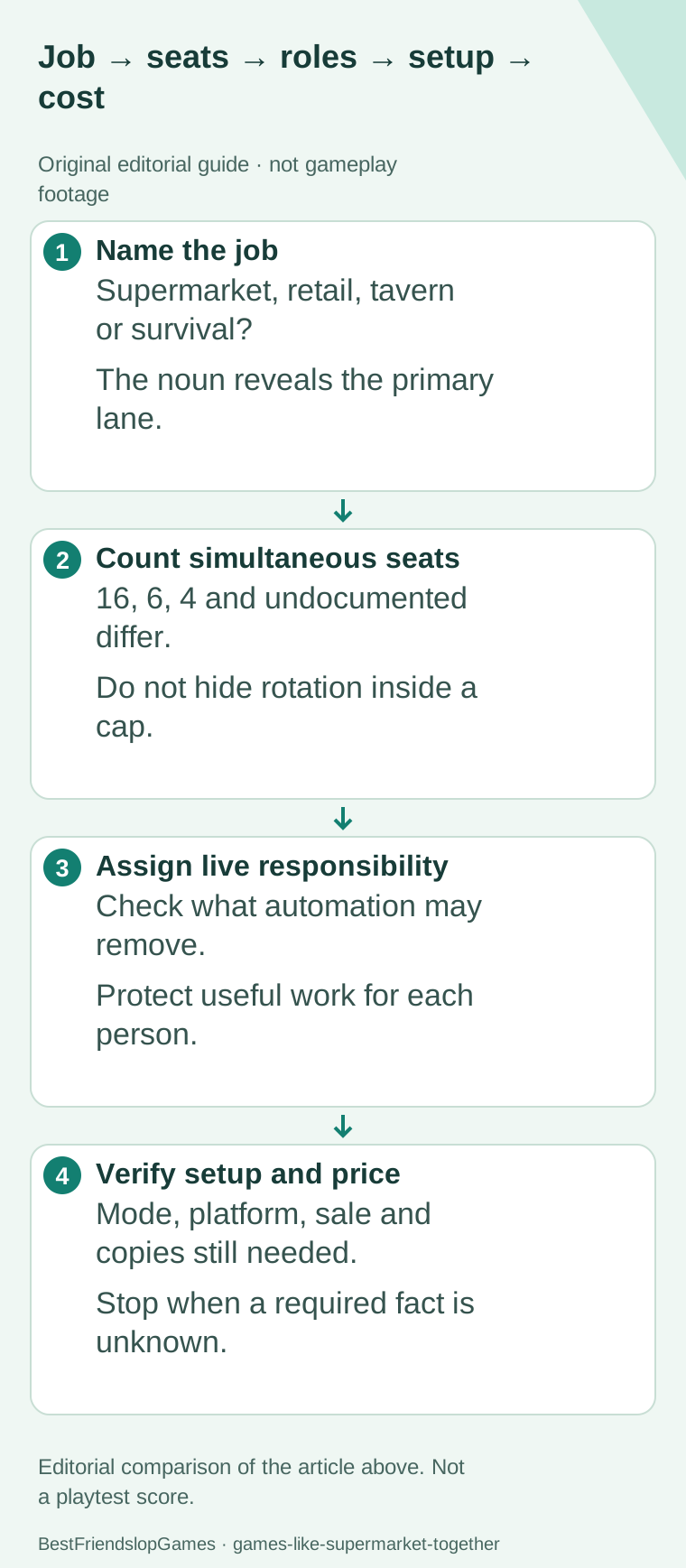
- Name the shared job: supermarket, retail shop, tavern or survival camp.
- Count simultaneous players from the official arrangement; do not turn a four-person cap into a rotation plan silently.
- Assign one first-session responsibility per person and identify which jobs automation may remove.
- Record base copies, sale expiry, accounts, hardware and optional spending before install night.
- Stop when a required platform, mode, player count or price is undocumented; do not fill it with a mod or another edition.
Editorial choice: Run the checklist from the hardest constraint to the easiest. Group size comes before genre preference because a missing seat cannot be repaired by a better theme. Mode comes before price because four cheap copies are useless when the intended arrangement is not documented. Work structure comes before visual similarity because the group will feel a missing job longer than a different art style. Budget comes last, but remains dated and explicit. This order leaves a defensible shortlist: Grocery Store Simulator for four grocery workers, Retail Company Simulator for four retail workers, Ale & Tale Tavern for up to six service-and-exploration players, and Valheim only for the separate Muck-like survival branch.
Quick questions
What is the closest checked alternative to Supermarket Together?
Grocery Store Simulator is the closest by workplace and advertised tasks: up to four players stock shelves, set prices, hire staff and expand a supermarket. It does not preserve Supermarket Together's free base entry or its up-to-16-player scale.
Which checked alternative supports the largest paid group?
Ale & Tale Tavern documents cooperative play for up to six people. Valheim supports one to ten, but it belongs to the Muck-like survival branch rather than the shop-service branch.
Is Muck another supermarket game?
No. Muck's official description identifies a survival roguelike about resources, items, base building and survival. It is included because the owner grouped the small games like muck query into this one page, not because the games share a retail setting.
Does free to play mean the whole setup costs nothing?
No. It establishes a $0 base-game entry in the checked Steam record. It does not include hardware, internet, optional purchases or the value of setup time.
Sources and scope
The linked official Steam pages supplied modes, advertised player arrangements, shared activities and the October 27, 2026 US price snapshots. GameSpot's current broad co-op list was read for its activity-first and player-count structure; it did not supply technical facts for these rows. Stack Up's Cooking Simulator 2 review was an adjacent example of separating a service-game premise from how cooperative work actually feels, not evidence about any listed product. Bits N' Pixels' 2026 co-op list was a broad adjacent list and did not document this supermarket family. Paragraphs marked “Editorial choice” are original decision rules derived from the disclosed official boundaries. The diagrams are original explanatory vectors, not gameplay screenshots.