Games Like Webfishing: Three Social Fishing Alternatives by What Your Group Does
The best games like Webfishing are Palia if your group wants a free social world with fishing among many life-sim activities, Luma Island if four friends want a private paid adventure with fishing, building and shared resources, and Fishing Planet if two to five friends want fishing itself to become deeper and more realistic. None is a one-for-one replacement for Webfishing's inexpensive animal-avatar chatroom. Pick whether your group wants conversation, a shared project or detailed angling to become the main event.
Official game, mode and US price records were checked October 26, 2026. This is a sourced comparison, not a playtest. It does not transfer a Steam feature to another platform edition. Return to the Best Friendslop Games directory for other group-night choices.
Start with Webfishing's actual combination
WEBFISHING describes itself as a multiplayer chatroom-focused fishing game. Its official Steam page lists single-player and online co-op, a $4.99 US base price, nearly 100 creatures, gear upgrades, cosmetics, props, instruments, chalk and social play with friends or strangers. The checked official listing does not state a numeric lobby cap. GameSpot's current online co-op list identifies the arrangement as one to twelve players; that number is kept as a secondary-source statement rather than relabeled as an official Steam specification.
The official Lobby Update also documents public, unlisted and private lobby types, tags, join requests and host controls. Those details matter because the product is not only a fishing system. It is a place where the host chooses who can enter, friends can talk during quiet gaps, and fishing supplies a low-pressure reason to remain together.
Editorial choice: Ask the group to rank three promises before looking at another cute fishing game: a conversation space, a fishing progression system and a shared world project. Webfishing gives each promise some room without making any one of them very demanding. A replacement usually enlarges one promise and shrinks another. If conversation is first, avoid a game whose systems require constant coordination. If fishing mastery is first, accept that tackle and conditions may interrupt the chat. If a lasting town or island is first, agree that somebody's world state may matter after the evening ends. The right substitute is the one that changes the lowest-ranked promise, not the one with the closest screenshots.
Compare the social structure, fishing role and entry budget
“Online co-op” does not describe the same relationship in every row. Palia separates a four-person party from its larger server and Community systems. Luma Island offers one-to-four-player drop-in/drop-out play with shared resources and building. Fishing Planet describes MMO and online co-op features, but the official numerical statement used here is specifically two to five friends on the same ocean-fishing yacht. Prices are base-entry snapshots before tax; free-to-play entries can still include optional purchases or account requirements.
| Game and official source | Documented group arrangement | What friends do between catches | Entry price checked Oct. 26 | Four new entries |
|---|---|---|---|---|
| WEBFISHING — reference | Online co-op; official Steam page omits a numeric cap; GameSpot lists 1–12 | Chat, collect nearly 100 creatures, customize, draw, play instruments and use toys | $4.99 | $19.96 |
| Palia | Online co-op and cross-platform multiplayer; official support identifies a party size of 4, while servers and Communities are larger | Fish inside a broader life sim with homes, crafting, exploration and other players | Free to play; third-party Palia account and in-app purchases listed | $0 base entry |
| Luma Island | 1–4 online co-op; drop-in/drop-out | Fish, choose professions, explore, share resources, solve challenges and build side by side | $19.99 | $79.96 |
| Fishing Planet | MMO and online co-op; ocean yachts accommodate 2–5 friends together | Select tackle, read conditions, fish realistic waterways, join clubs, chat and compete | Free to play; email registration, in-app purchases and kernel anti-cheat listed | $0 base entry |
Four-entry totals are simple dated arithmetic: 4 × $4.99 = $19.96, 4 × $0 = $0, and 4 × $19.99 = $79.96. They exclude tax, hardware, subscriptions and optional purchases. A zero-dollar base entry is not a zero-cost promise, and a four-entry total does not prove that four people share every activity in exactly the same way.
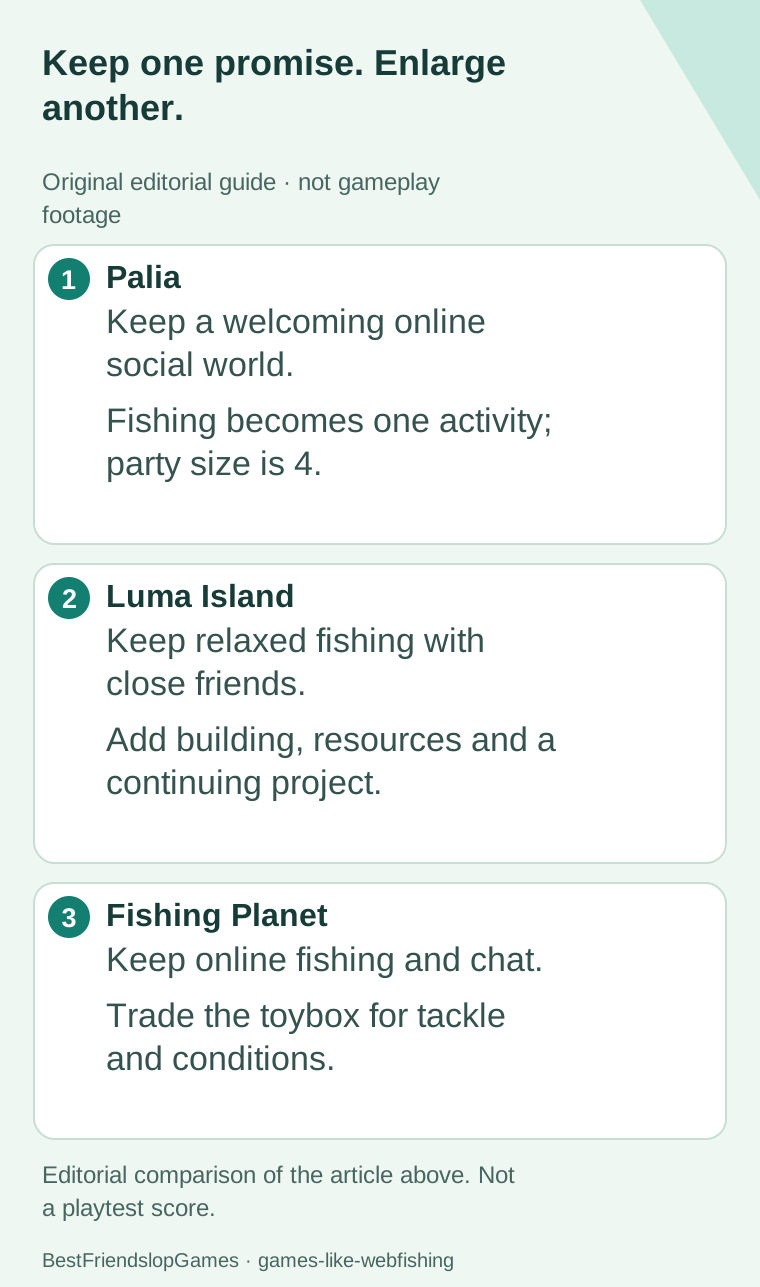
Palia: keep the social world, make fishing one activity among many
Documented fit: Palia's official Steam record describes a free-to-play fantasy life-sim adventure with single-player, online co-op, cross-platform multiplayer and in-app purchases. It requires a Palia account linked to Steam. The official gameplay support page distinguishes a party size of four from larger Community and server populations. Fishing sits beside crafting, exploration and home creation rather than standing alone as the entire loop.
Documented boundary: A four-person party is not equivalent to Webfishing's GameSpot-listed twelve-person lobby. Nor does a larger shared server mean that every nearby player is part of one coordinated four-person party. Palia also brings an account setup and optional spending layer that a $4.99 base purchase comparison must keep visible. Its cross-platform label is documented, but this page does not promise identical controls or store terms on every system.
Editorial choice: Choose Palia when the friends who stop fishing need somewhere else to go without leaving the social world. One person can pursue a house or crafting task while another fishes, so silence does not mean the session has stalled. That freedom also weakens Webfishing's simple social contract: everyone is no longer gathered around the same low-stakes activity. Before installing, decide whether “together” means being in the same party and activity or merely inhabiting the same world while talking. Use the four-person party as the coordination unit, not the server population. If five close friends must move as one group, resolve that limit before treating free entry as the answer.
Luma Island: turn the hangout into a four-person shared project
Documented fit: Luma Island's official Steam page advertises one-to-four-player online co-op and drop-in/drop-out multiplayer. Friends can fish, mine, craft, select professions, share resources, tackle challenges and build side by side. The page also lists Cozy, Adventure and Hero modes, allowing the host group to choose how much combat pressure joins the island routine. Its checked US base price is $19.99.
Documented boundary: Four players is a hard documented planning number for this comparison, not a substitute for a larger chatroom. Building, quests and shared resources create decisions that persist beyond a single fishing conversation. The $79.96 four-copy total is four times Webfishing's $19.96 four-copy base total at the checked prices. That price difference purchases a broader shared adventure, not proof of four times the value or four times the playtime.
Editorial choice: Put Luma Island first when friends want the evening to leave evidence: a built area, gathered materials, profession progress or a completed challenge. Give each person one voluntary lane—fishing, gathering, building or exploration—then rotate only if someone feels trapped in a job. That preserves casual conversation while preventing one confident player from converting a cozy island into a work queue. Pick Cozy mode if combat would repeatedly cut off the chat; pick Adventure or Hero only if interruption is part of the desired night. Reject this branch when more than four people must participate simultaneously or when the group wants a fresh public room rather than somebody's continuing project.
Fishing Planet: keep online fishing, replace the toybox with technique
Documented fit: Fishing Planet calls itself a realistic first-person online multiplayer fishing simulator. Its Steam record lists MMO, online co-op, online PvP, in-app purchases and a required email registration. The official description says ocean-fishing yachts can accommodate two to five friends simultaneously, supports Fishing Clubs and chat, and documents more than 300 fish species, 27 waterways, multiple fishing methods and large tackle combinations. Base entry is free to play.
Documented boundary: The two-to-five yacht statement is a specific cooperative fishing arrangement, not a claimed cap for every MMO space, club or competition. Realistic conditions, tackle selection, fish behavior, leaderboards and competitions make fishing a more demanding foreground activity than Webfishing's chatroom toybox. The Steam page also discloses optional purchases and kernel-level anti-cheat, which belong in the installation decision even though the base entry price is $0.
Editorial choice: Choose Fishing Planet when the group becomes bored if catching stays mechanically simple. Give the most experienced player a teaching limit: explain one piece of tackle or one environmental condition at a time, then let everyone make a cast before adding another rule. This protects the conversation from becoming a lecture and exposes whether the group likes angling knowledge or only liked having rods in a social room. Use the documented two-to-five yacht range for the shared-boat plan and keep larger club or public-space expectations separate. If cosmetics, animal avatars, drawing and instruments were the real attraction, free entry will not restore those missing toys.
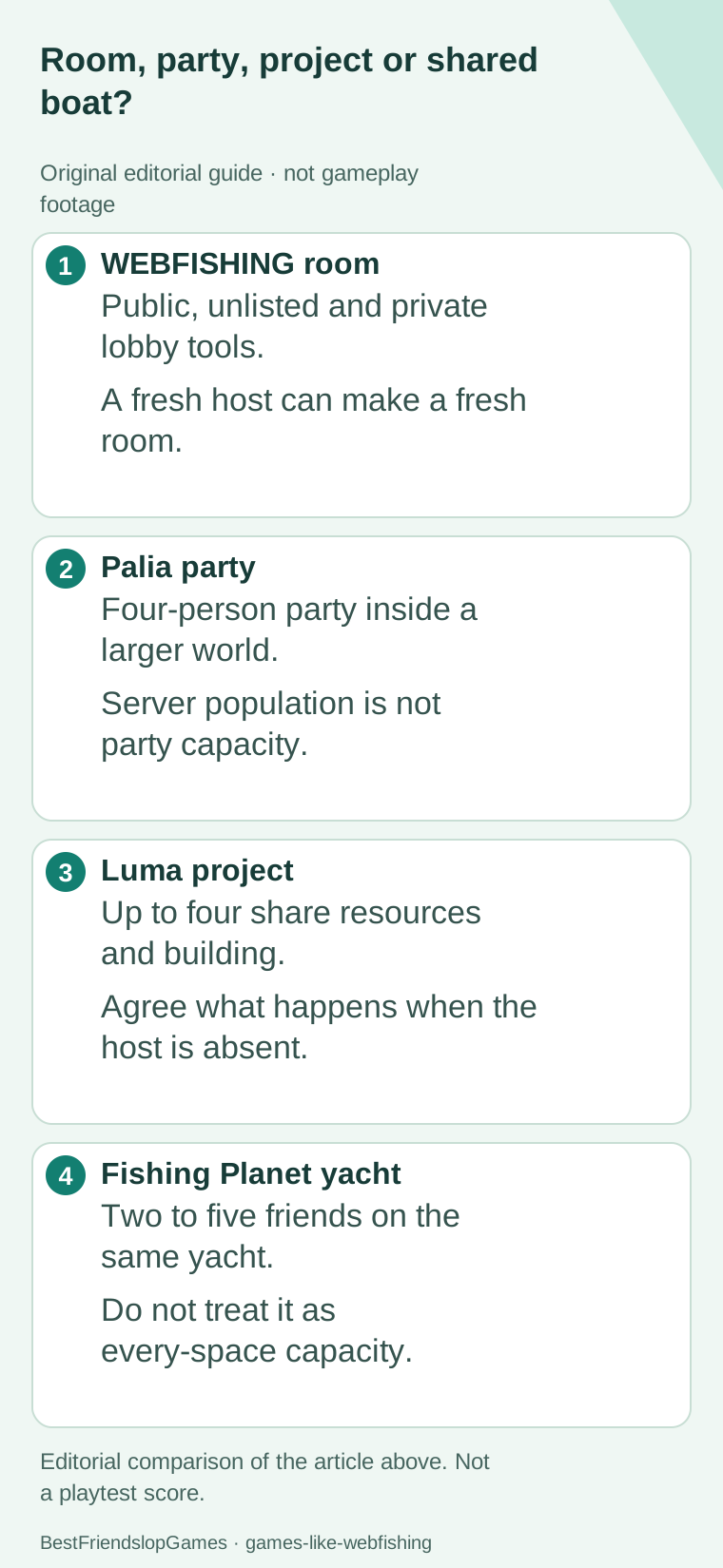
Decide whether the friends or the world own the schedule
Webfishing's official lobby tools let a host choose public, unlisted or private access and manage join requests. Palia's party, Community and server layers divide close coordination from the broader population. Luma Island's continuing resources and building make the shared world part of the relationship. Fishing Planet combines clubs and chats with locations, equipment and competitive records.
Editorial choice: Write one sentence describing what happens when the usual host is absent. A useful plan says either “anyone can create a fresh room,” “we can meet in the larger world without the party leader,” “the project waits for its host,” or “we fish independently and regroup in chat.” Do not discover ownership and access rules after six people have installed. Webfishing is easy to treat as a disposable room; a persistent home or island can create stronger attachment and stronger scheduling dependence. If the group changes members every week, favor a low-commitment meeting place. If the same four return reliably, a continuing project can make the next date easier to plan.
Price the first gathering, then price the habit
At the checked prices, four new Webfishing copies cost $19.96 and four new Luma Island copies cost $79.96. Palia and Fishing Planet have $0 base entry for four, but both list in-app purchases; Palia requires a Palia account, while Fishing Planet requires email registration and lists kernel-level anti-cheat. These are not interchangeable cost structures.
Editorial choice: Split the budget into three columns: required before the first gathering, optional after the group likes the game and external setup. Put base copies and required subscriptions in the first column, cosmetics or content packs in the second, and hardware/accounts in the third. A free-to-play row wins the first-column comparison but can still lose the group's privacy, installation or spending-policy check. Set an optional-spend rule before anyone buys a pack to “catch up.” For the paid rows, subtract copies already owned instead of repeating the four-copy headline. Recheck checkout pages because the dated figures are evidence of this comparison, not a future sale promise.
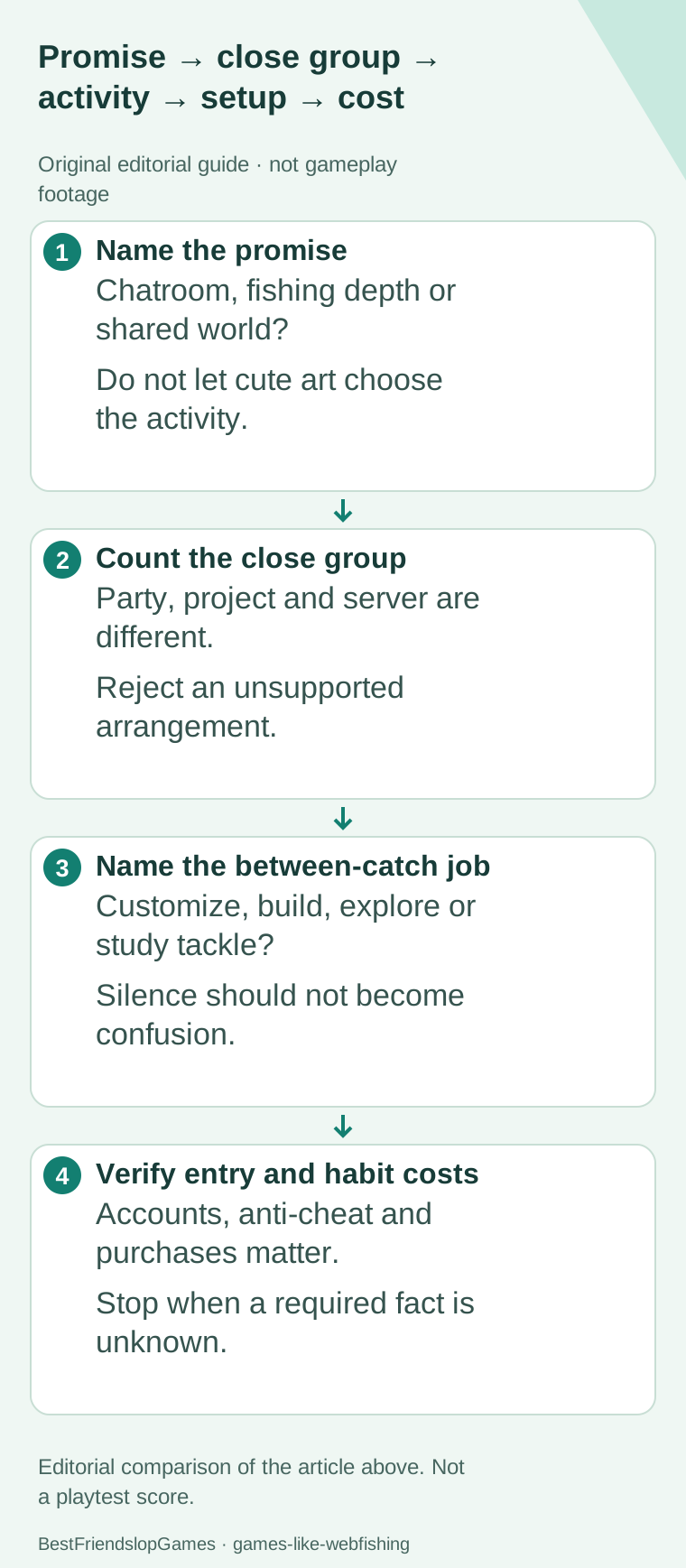
Use this five-step Webfishing replacement check
- Name the part everyone wants again: chatroom, fishing progression or a continuing world.
- Count the close group using the documented party or shared-activity number, not a server population.
- Decide what friends do when they are not fishing: customize, build, explore or study tackle.
- Record account, anti-cheat, platform and optional-purchase requirements before installation night.
- Recalculate only the new entries still needed and stop when a required arrangement is undocumented.
Editorial choice: Treat a missing fact as a stop sign, not a blank to fill with another platform, a mod or a community anecdote. The checked Steam page does not publish Webfishing's numeric lobby cap, so this article labels GameSpot's one-to-twelve figure as secondary. Fishing Planet's two-to-five statement applies to an ocean yacht, not every multiplayer space. Palia's four-person party is not its total server population. Those boundaries make the comparison less tidy, but they prevent a familiar “multiplayer” label from promising the wrong room. The group can tolerate a different activity; it cannot use a seat that does not exist.
Quick questions
Which alternative is closest to a free social hangout?
Palia is the closest of these three if a broad social world matters more than keeping fishing central. Its base entry is free, its official support identifies a four-person party, and fishing shares the world with homes, crafting and exploration. It is not a twelve-person private fishing-room replacement.
Which option keeps fishing as the deepest activity?
Fishing Planet puts angling technique, waterways, species, tackle and conditions in the foreground. That is a documented mechanical shift away from Webfishing's chatroom, cosmetics and toys, not a claim that one style is better.
Which option gives four friends a continuing shared project?
Luma Island supports one-to-four-player online co-op with shared resources, building, professions and challenges. Its checked four-copy base total is $79.96 before tax and hardware.
Can these alternatives replace a twelve-person Webfishing lobby?
Not as one documented close-group arrangement. Palia's party is four, Luma Island is one to four, and Fishing Planet documents two to five friends on one ocean yacht. Palia servers and Communities can contain more people, but that does not turn them into one larger coordinated party.
Sources and scope
The linked official Steam records, Palia support page and Webfishing official announcements supplied the October 26 modes, activity descriptions, access requirements and US price snapshots. GameSpot's online co-op list supplied the explicitly secondary one-to-twelve Webfishing figure and a concise activity-first structure. Stack Up's current PAX West roundup was read as an adjacent example of explaining what friends actually do together, not as Webfishing evidence. Bits N' Pixels' 2026 co-op list was a broad adjacent reading only; it did not provide technical facts for these rows. Community reviews, mods and player comments were not used to establish modes, capacities or prices. Paragraphs labelled “Editorial choice” are original decision rules derived from the documented boundaries. The diagrams are original explanatory vectors, not gameplay screenshots.